



A critical security vulnerability (CVE-2025-55182) was disclosed in React Server Components in December 2025, impacting React Server DOM packages used for Server Components and Server Functions in React 19 (versions 19.0.0, 19.1.0, 19.1.1, and 19.2.0). The issue enables unauthenticated remote code execution via crafted requests due to unsafe payload deserialization, and was patched in React releases 19.0.1, 19.1.2, and 19.2.1. Frameworks implementing React Server Components inherit the vulnerability, including Next.js versions using the App Router and Server Actions; affected Next.js versions include 15.x, 16.x, and canary builds starting from 14.3.0-canary.77, with fixes available in Next.js 15.0.5+, 15.1.9+, 15.2.6+, 15.3.6+, 15.4.8+, 15.5.7+, and 16.0.7 or later.
UPDATE: The IONIX research team developed a simulation to validate exposure to CVE-2025-55182 and the related Next.js advisory CVE-2025-66478. Confirmed findings are listed in this post.
Live Exposure Defense: From CVE to Confirmed Exposure in 12 Hours – See more

- Platform
- Attack Surface VisibilityFrom Blind Spots to Complete Attack Surface Visibility
- Exposure ValidationIdentify, Prioritize, and Fix Critical Exposures
- Streamlined Risk WorkflowStreamline Operations to Reduce MTTR
- Active ProtectionStop Asset Takeovers Before they Become Incidents
- WAF Posture ManagementTake control of every WAF across every domain
- Live Exposure DefenseFrom CVE to Confirmed Exposure in 12 Hours
- Solutions
- CTEM – Expose and Manage ThreatsContinuously identify, expose and remediate critical threats
- EASM – Attack Surface ManagementThe roadmap to reducing your attack surface
- CNAPP Validation – Cloud Attack SurfaceReduce Cloud Security Noise by Focusing on What Really Matters
- Control Subsidiary RiskManage cyber risk across all your subsidiaries
- Improve Security PostureReduce risk systematically
- Manage M&A riskEvaluate candidate’s cyber risk
- Threat Center
- Learn
- Company
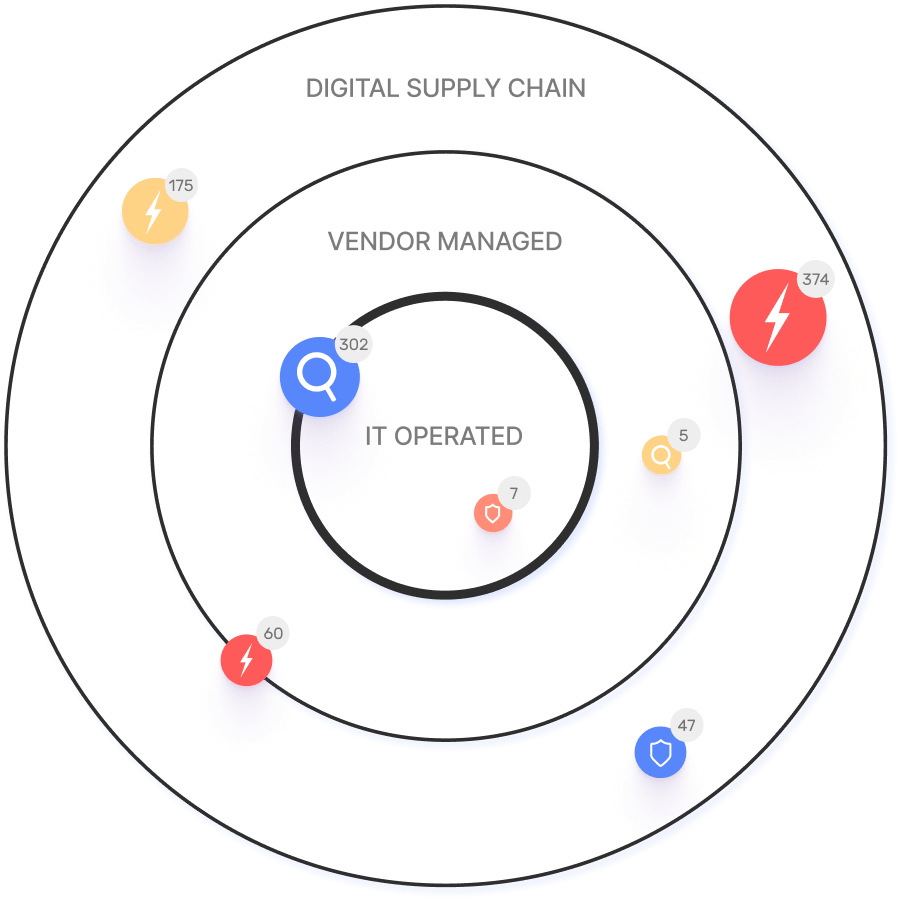
 Threat Exposure Radar ExplainedSolutions
 - Mapping of all Assets with this Technology
- Identification of potentially exposed assets to this CVE
- Confirmation of verified exploitable assets
- Mapping of all Assets with this Technology
- Identification of potentially exposed assets to this CVE
- Confirmation of verified exploitable assets
 IONIX Cloud Exposure ValidatorProduct
 New CVE Detected
CVE-2025-55182 – Unauthenticated Remote code execution vulnerability in React Server Components
Are you exposed?
Get a free report of your organization’s exposure to this CVE and threat
How IONIX’s External Exposure Management Platform Detects and Validates
Zero-Days to Shrink MTTR1
Map your entire attack surface (continously)
IONIX uses multi-factor discovery methods, including DNS analysis, certificate mapping, metadata inspection, and more, to automatically map every internet-facing asset across your environment. This includes cloud instances, third-party platforms, shadow IT, and even forgotten infrastructure that traditional tools miss.
2
Monitor for new CVEs
Dozens of threat intel feeds using agentic technology are continuously analyzed to detect the appearance of proof-of-concept code, exploit kits, and indicators of active targeting. IONIX goes further by applying AI to proactively evaluate whether emerging vulnerabilities are likely to be exploited, even before PoCs go public.
3
Identify Potential External Exposures
Not all CVEs matter. IONIX filters vulnerabilities by asking attacker-centric questions: Can it be reached from the internet? Does it require authentication? Is it being exploited in the wild? This dramatically reduces noise and focuses teams on threats that can actually be weaponized.
4
Create Safe, Scalable Exploit Validations
IONIX transforms real-world PoCs into safe, non-intrusive test payloads that can be run in production environments without disruption. These simulations are precisely targeted to the systems that are vulnerable, ensuring rapid validation without unnecessary load.
5
Execute Exploit Validations
By combining context about software stack, versioning, exposure status, and reachability, IONIX ensures that only the right payloads are executed against the right assets, maximizing efficiency and minimizing risk.
6
Drive Fast and Actionable Remediation
Results are routed through integrations with ticketing, SOAR, and SIEM tools. Issues are written in plain language, bundled into remediation clusters, and prioritized based on asset criticality, exploitability, and blast radius. This shortens mean time to remediation (MTTR) and empowers teams to act with confidence.
Are you exposed?
Get a free report of your organization’s exposure to this CVE and threat