
Does a WAF Stop php2shell? What the Data Says About Virtual Patching


A WAF stops php2shell for the assets behind it, with rules in block mode, where the origin cannot be reached any other way. Across hundreds of organizations in IONIX’s State of the WAF report, 47% of live internet-facing web applications fail the first of those three conditions. That is the whole answer, and the rest of this post is the data behind it and what to do with the hosts that have nothing in front of them.
The WAF vendors moved first, and said what they could not do
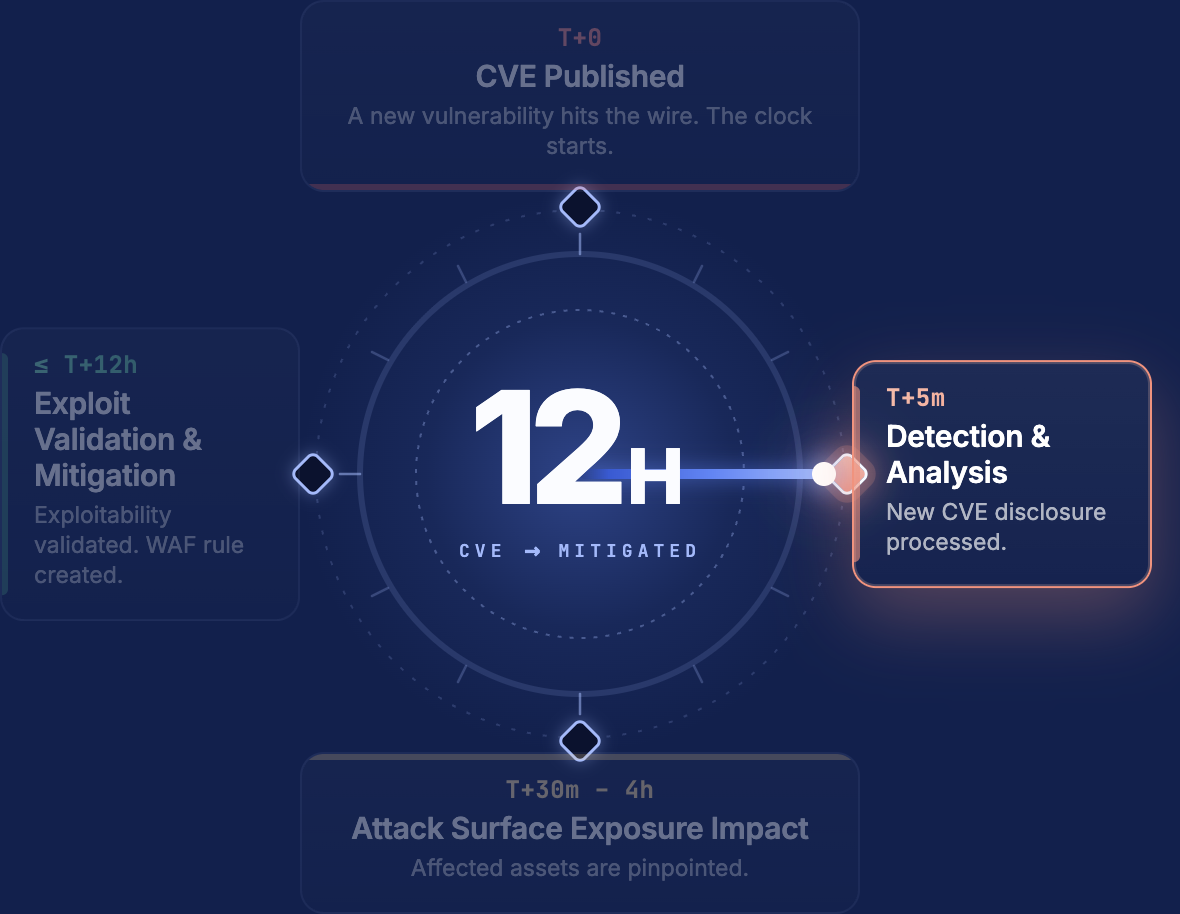
Cloudflare’s php2shell rules started blocking at 03:02 UTC on October 21, about nine hours before PHP’s advisory went public, on every plan including Free. IONIX Research published tested Cloudflare and Akamai rule guidance in its rolling advisory the same day. For an exploit that leaked a day early, that was the fastest control anyone deployed.
Every one of those vendors also said the same thing about their own rules. Cloudflare: not a fix, the flaw is in the PHP runtime, and attackers were mutating payloads to evade the rules within the first day. PHP’s core developers: "ini settings won’t save you." IONIX: no WAF signature can be counted on to block these bugs, CDN and cloud WAFs inspect only the first part of a request body, and the rules do not cover the other trigger paths for CVE-2026-109619.
The WAF bought time. The question for every security team was how many of their PHP hosts it bought time for.
What the attack surface data shows
IONIX’s State of the WAF report, published in October 2026, measured WAF protection the way an attacker would: five attack probes against every live web application across hundreds of organizations, with an application counted as protected only if it blocked at least one.
| Measure | Finding |
|---|---|
| Live web applications with no blocking firewall | 47% |
| Login pages with no blocking firewall | 47% |
| Applications on WAF-capable hosting with nothing blocking | 44% |
| WAF or CDN vendors fingerprinted at the median organization | 11 |
| Of those, proven to block an attack | 3 |
| Organizations with no proven blocking vendor at all | 11% |
| WAF-protected applications whose origin answered a direct request | 29% |
| Of those bypasses, needing only the correct Host header | 80% |
About half of the web applications a security team is responsible for have nothing in front of them that blocks. For those hosts, Cloudflare’s nine-hour head start changed nothing. The php2shell request went to the PHP worker unfiltered.
Three ways a WAF that exists still fails
The 47% figure counts applications with no blocking firewall at all. The gap between "has a WAF" and "is protected" is wider than that, for three reasons the php2shell week made concrete.
Monitor mode. Paid Cloudflare plans need the managed ruleset deployed in block mode, not log mode, for the php2shell rules to stop anything. The same holds for every vendor. A WAF in monitoring mode produces a tidy log of the request that compromised the server. The State of the WAF data found 38% of applications behind a blocking WAF still let an SQL injection probe through, and WAF modules bundled into CDN and cloud platforms blocked it on 45% of applications versus 97% for dedicated WAF products.
Origin bypass. A WAF inspects traffic that passes through it. 29% of WAF-protected applications with a testable origin answered requests sent directly to the origin, and 80% of those bypasses needed nothing more than the correct Host header. An attacker who finds the origin IP, from a DNS history service or a certificate transparency log, sends the php2shell payload straight past the WAF.
Rule gaps. Cloudflare’s rule for the third PHP CVE, CVE-2026-115560, matches PHP’s default session upload progress field name. A site that renamed that field, which PHP recommends as hardening, is not covered. Mutated payloads for the first two CVEs forced rule updates within hours. IONIX’s advisory notes that the size-cap rule misses an out-of-memory variant that uses many small part headers, and that a CDN rule inspecting only the first part of a multipart body can be padded past. Each gap is small. Together they mean "behind a WAF" is a probability, not a guarantee.
What to do with the unprotected half
The hosts with no blocking WAF are the patch order. For php2shell, that means:
- Patch the unprotected hosts first. A vulnerable PHP host with no WAF has been exposed to every scanner on the internet since the exploit became public. Fixed versions are 8.5.12, 8.4.27, 8.3.36, and 8.2.35, plus distribution backports for older branches.
- Put a WAF in front of what cannot be patched this week. End-of-life PHP branches need a migration, not a patch. Those hosts get a blocking WAF, origin lockdown, and the configuration mitigations from PHP’s advisory while the migration runs.
- Audit the hosts that count as "protected." Confirm block mode. Confirm the origin only accepts traffic from the WAF’s IP ranges. Confirm the rules match the configuration the host runs, including any renamed session fields.
- Re-test after every rule change. Cloudflare updated rules as payloads mutated. The rule that blocked on Tuesday is not evidence the rule blocks on Friday.
How IONIX turns this into a standing control
WAF Posture Management is the IONIX module that audits WAF coverage across the discovered external attack surface, validates that the protection in place blocks representative attacks, and recommends deployable rules for confirmed exploitable web assets. It is the same measurement the State of the WAF report is built on, run continuously against one organization instead of once across hundreds.
For a disclosure like php2shell, that produces three lists: affected hosts with no blocking WAF, which become the top of the patch order; hosts with a WAF present but not blocking, which become the configuration fix list; and hosts that are covered, with the vendor rules to confirm and the coverage limits to keep in mind.
The point is to have the answer before the disclosure. A WAF coverage audit run on October 20 tells you on October 21 which hosts have hours and which have minutes. An audit run on October 24 tells you which hosts were exposed on October 22.
Find out which of your PHP hosts have no WAF
The free php2shell assessment maps every internet-facing PHP asset across your organization, subsidiaries, and digital supply chain, and reports which ones sit behind a blocking WAF. Company name only, results within 24 hours.
Request your free php2shell assessment
FAQs about php2shell WAF
Cloudflare deployed php2shell rules at 03:02 UTC on October 21, 2026, on all plans, and inspects both requests and origin responses. Protection applies only to hostnames proxied through Cloudflare, with the managed ruleset in block mode on paid plans. Requests that reach the origin directly bypass it, and Cloudflare reported attackers mutating payloads to evade rules within the first day. Cloudflare calls the rules a stopgap and says patching PHP is the fix.
IONIX’s State of the WAF report, based on active probing across hundreds of organizations in 2026, found 47% of live internet-facing web applications have no blocking firewall. The median organization has 11 WAF or CDN vendors fingerprinted but only 3 proven to block an attack.
Yes, in three common ways: sending the request directly to the origin IP when the origin accepts traffic from anywhere, exploiting a WAF left in monitoring rather than blocking mode, and mutating the payload to miss a signature. IONIX’s State of the WAF report found 29% of WAF-protected applications with a testable origin answered direct requests, and 80% of those bypasses needed only the correct Host header.
No. PHP’s advisory states that updating to a fixed version is the only complete mitigation. A WAF reduces exposure on hosts that cannot be patched this week, provided it is in block mode with the origin locked down. It is the right control for end-of-life PHP branches during a migration, not a replacement for the migration.