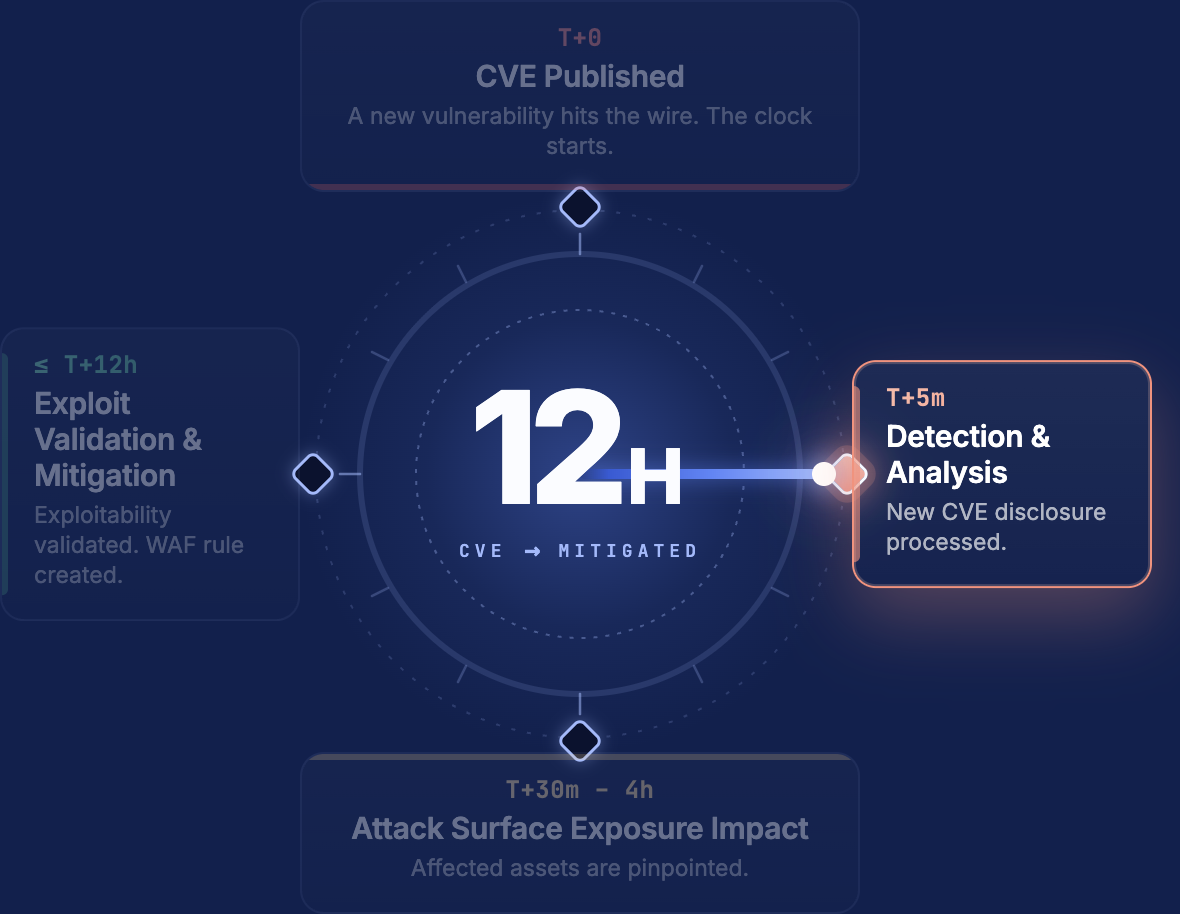
Live Exposure Defense: From CVE to Confirmed Exposure in 12 Hours – See more

IONIX vs Hadrian

Hadrian thinks like an attacker. IONIX covers your whole organization.

Hadrian simulates how an attacker finds and tests targets, and does it well. IONIX brings that attacker’s view to your entire organization, including subsidiaries and supply chain, validates what is exploitable, and mitigates it inside a 12-hour SLA.

97% drop in false-positive alerts. 90% reduction in MTTR for external exposures.

IONIX vs Hadrian
Feature comparison

IONIX vs Hadrian at a glance

A side-by-side look at how the two platforms handle the work that matters most to exposure management teams.

Capability
Adversary-centric discoveryFinds assets the way an attacker would External-first discovery Agentic attacker simulation
Organizational entity mappingVerified model including subsidiaries and acquisitions Connective Intelligence ~Discovery-led
Validated exploitabilityConfirms an exposure is reachable and exploitable Non-intrusive simulation Agentic pentesting (Nova)
Supply chain and subsidiary exposureExposure through third parties and acquisitions Exposure by Association Owned assets only
Risk scoring and prioritizationRanks by asset importance, EPSS, and blast radius Blast radius, business impact ~Attacker-priority focus
Zero-day mitigationCVE to validated, mitigated exposure in 12 hours Live Exposure Defense, 12-hour SLA No mitigation SLA
Active mitigationStop takeovers, not just detect them Active Protection Detection and testing
Enterprise scale and integrationsProven deployments, JIRA and ServiceNow workflows Enterprise-proven ~Newer, European focus
Whole-Org Coverage

An attacker's view of your whole organization

Hadrian’s adversary simulation is sharp on the assets it points at. Its scope centers on directly owned, internet-facing infrastructure. Subsidiaries, acquisitions, and digital supply chain dependencies sit outside the primary picture, and that is where enterprise attackers start.

IONIX maps your organizational entity model first, then discovers and validates exposure across the full footprint, including the companies you acquired and the third parties you depend on.

Exposure by association

The breach comes from who you are connected to

Hadrian does not lead with subsidiary or supply chain coverage. For a single business unit that is fine. For an enterprise with acquisitions and a deep vendor chain, the most likely breach path goes unmonitored.

IONIX traces and validates exposure across subsidiaries, acquisitions, and supply chain dependencies, giving the weakest link the same scrutiny as your primary domain.

Validated at enterprise scale

Adversary simulation, proven across the enterprise

Hadrian is a newer, European-focused vendor with strong practitioner credibility and GigaOm recognition, and its Nova product adds continuous offensive testing. For large, distributed organizations, the open question is scope and operational depth across thousands of assets and many entities.

IONIX pairs active, non-intrusive validation with established enterprise deployments, multi-factor ML attribution, blast-radius prioritization, and grouped remediation that routes into JIRA and ServiceNow. The result is a 97% drop in false-positive alerts.

Mitigation, not management

Test it, then close it

Hadrian finds and tests exposures. Closing them still falls to your team, and attackers exploit new CVEs within hours of disclosure. Offensive testing surfaces the problem, it does not shut it.

IONIX closes the loop. Live Exposure Defense puts a 12-hour SLA on the path from CVE publication to validated, exploitable exposure, then recommends specific WAF rules ready to deploy through Akamai, Cloudflare, AWS, Azure, and other supported vendors. Active Protection goes further, automatically claiming dangling domains and abandoned cloud assets before attackers reach them. Humans govern, agents operate.

Get the attacker's view of your whole organization, then mitigate what they would hit.

Book a 30-minute demo and watch IONIX map your real attack surface in minutes.