
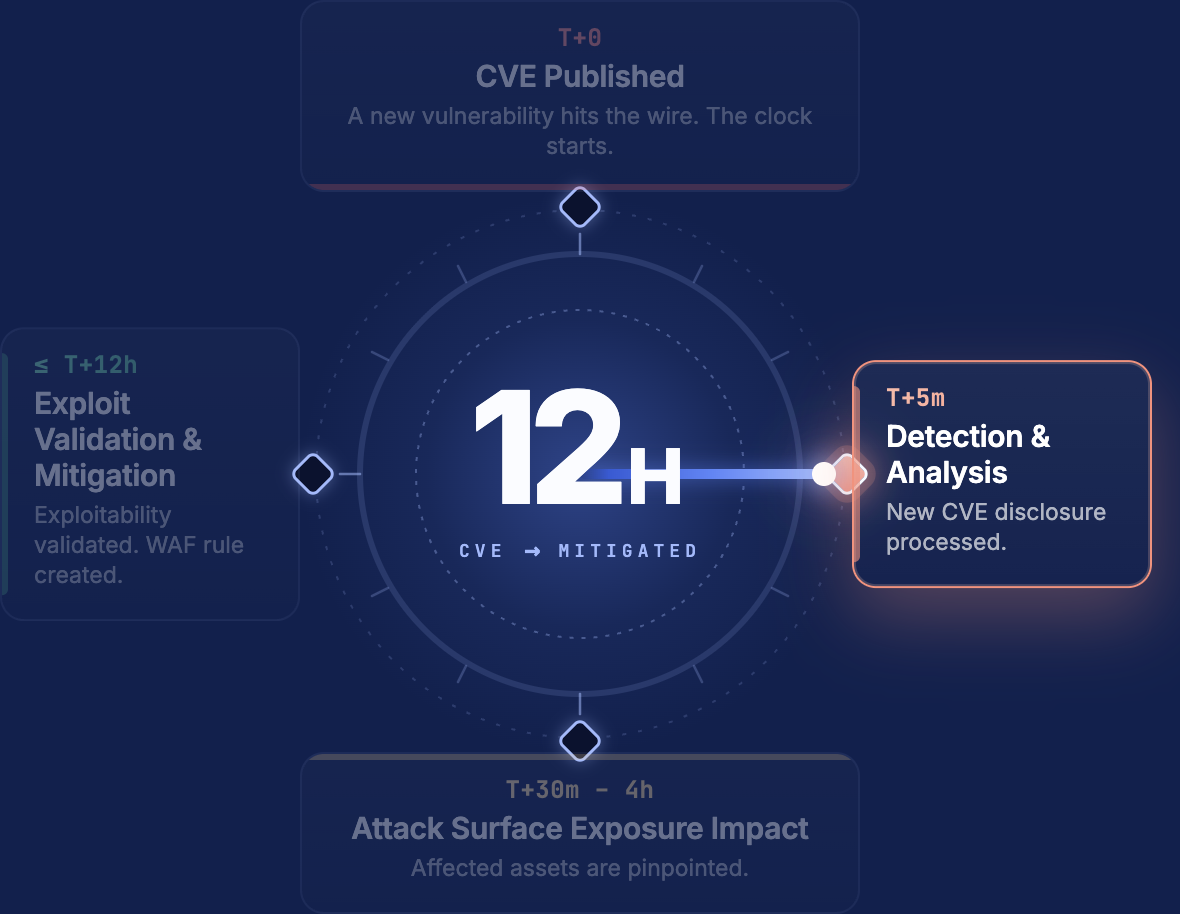

Live Exposure Defense: From CVE to Confirmed Exposure in 12 Hours – See more

New CVE Detected

CVE-2026-105215 – Authentication Bypass / Account Pre-Hijacking – ZITADEL 3.x before 3.4.14 and 4.x

Be the first to know when new zero-days emerge:

Summary

CVE-2026-105215 is a critical authentication bypass (CWE-290, Authentication Bypass by Spoofing) affecting ZITADEL’s hosted Login V1 UI. The registration endpoint used when an external identity is "not found" accepts client-supplied external identity fields (IdP config ID and external user ID) without requiring a completed, verified IdP callback, allowing an unauthenticated attacker to pre-create an account bound to a victim’s external identity. The flaw carries a CVSS score of 9.3 and affects ZITADEL 3.x before 3.4.14 and 4.x before 4.16.2.

Technical details

  • Root cause: Login V1’s registration flow trusted identity/verification flags and external identity fields (IDPConfigID, ExternalUserID) submitted directly in the registration form body, instead of requiring cryptographically verified data from a completed IdP authentication callback.
  • Trigger conditions: The target tenant must have an external IdP configured with "Account creation allowed (manually)" enabled on Login V1. The vulnerability does not require the victim to have interacted with the attacker in any way.
  • Attack vector: Network-based, unauthenticated, no user interaction required (AV:N/AC:L/PR:N/UI:N).
  • Impact: An attacker forges IDPConfigID and ExternalUserID values to pre-create a local account linked to a victim’s external IdP identity. When the victim later authenticates genuinely through that external IdP, they are signed into the attacker-controlled, pre-created account, resulting in account hijacking and compromise of confidentiality and integrity.
  • Login V2 is not affected, since it relies on cryptographically bound IdP intent mechanisms rather than client-supplied form data.

Affected software

  • ZITADEL 3.x: versions 3.0.0 through 3.4.13 (including release candidates) — fixed in 3.4.14
  • ZITADEL 4.x: versions 4.0.0 through 4.16.1 (including release candidates) — fixed in 4.16.2

Severity

  • CVSS Score: 9.3 (Critical)
  • CVSS v3.1 Vector: CVSS:3.1/AV:N/AC:L/PR:N/UI:N/S:U/C:H/I:H/A:N

Mitigation and recommended actions

  • Immediate: Upgrade ZITADEL to version 3.4.14 (3.x branch) or 4.16.2 (4.x branch) or later.
  • If immediate patching is not possible:
    • Disable "Account creation allowed (manually)" for all configured external IdPs on Login V1, relying only on "Automatic creation," which only executes after a verified IdP callback using server-side data.
    • Avoid enabling both manual and automatic account creation simultaneously, as this leaves the vulnerable code path exposed.
    • Consider migrating affected tenants to Login V2, which is not impacted by this flaw.

References

Are you exposed?

Get a free report of your organization’s exposure to this CVE and threat

How IONIX’s External Exposure Management Platform Detects and Validates
Zero-Days to Shrink MTTR

1

Map your entire attack surface (continously)

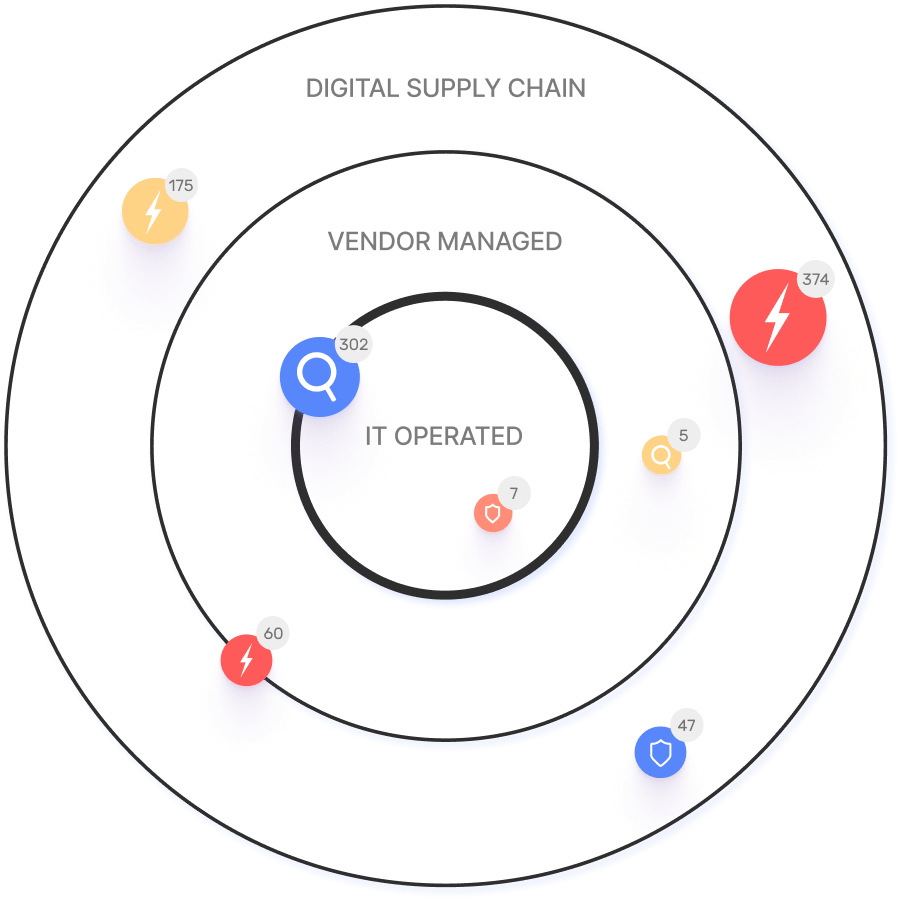
IONIX uses multi-factor discovery methods, including DNS analysis, certificate mapping, metadata inspection, and more, to automatically map every internet-facing asset across your environment. This includes cloud instances, third-party platforms, shadow IT, and even forgotten infrastructure that traditional tools miss.

2

Monitor for new CVEs

Dozens of threat intel feeds using agentic technology are continuously analyzed to detect the appearance of proof-of-concept code, exploit kits, and indicators of active targeting. IONIX goes further by applying AI to proactively evaluate whether emerging vulnerabilities are likely to be exploited, even before PoCs go public.

3

Identify Potential External Exposures

Not all CVEs matter. IONIX filters vulnerabilities by asking attacker-centric questions: Can it be reached from the internet? Does it require authentication? Is it being exploited in the wild? This dramatically reduces noise and focuses teams on threats that can actually be weaponized.

4

Create Safe, Scalable Exploit Validations

IONIX transforms real-world PoCs into safe, non-intrusive test payloads that can be run in production environments without disruption. These simulations are precisely targeted to the systems that are vulnerable, ensuring rapid validation without unnecessary load.

5

Execute Exploit Validations

By combining context about software stack, versioning, exposure status, and reachability, IONIX ensures that only the right payloads are executed against the right assets, maximizing efficiency and minimizing risk.

6

Drive Fast and Actionable Remediation

Results are routed through integrations with ticketing, SOAR, and SIEM tools. Issues are written in plain language, bundled into remediation clusters, and prioritized based on asset criticality, exploitability, and blast radius. This shortens mean time to remediation (MTTR) and empowers teams to act with confidence.

Are you exposed?

Get a free report of your organization’s exposure to this CVE and threat

Subscribe to Threat Center RSS

Copy/paste the link below into your preferred RSS reader or follow these instructions to subscribe to Slack alerts.

Get Real-Time CVE Alerts to Your Email

Be the first to know when new zero-days emerge