
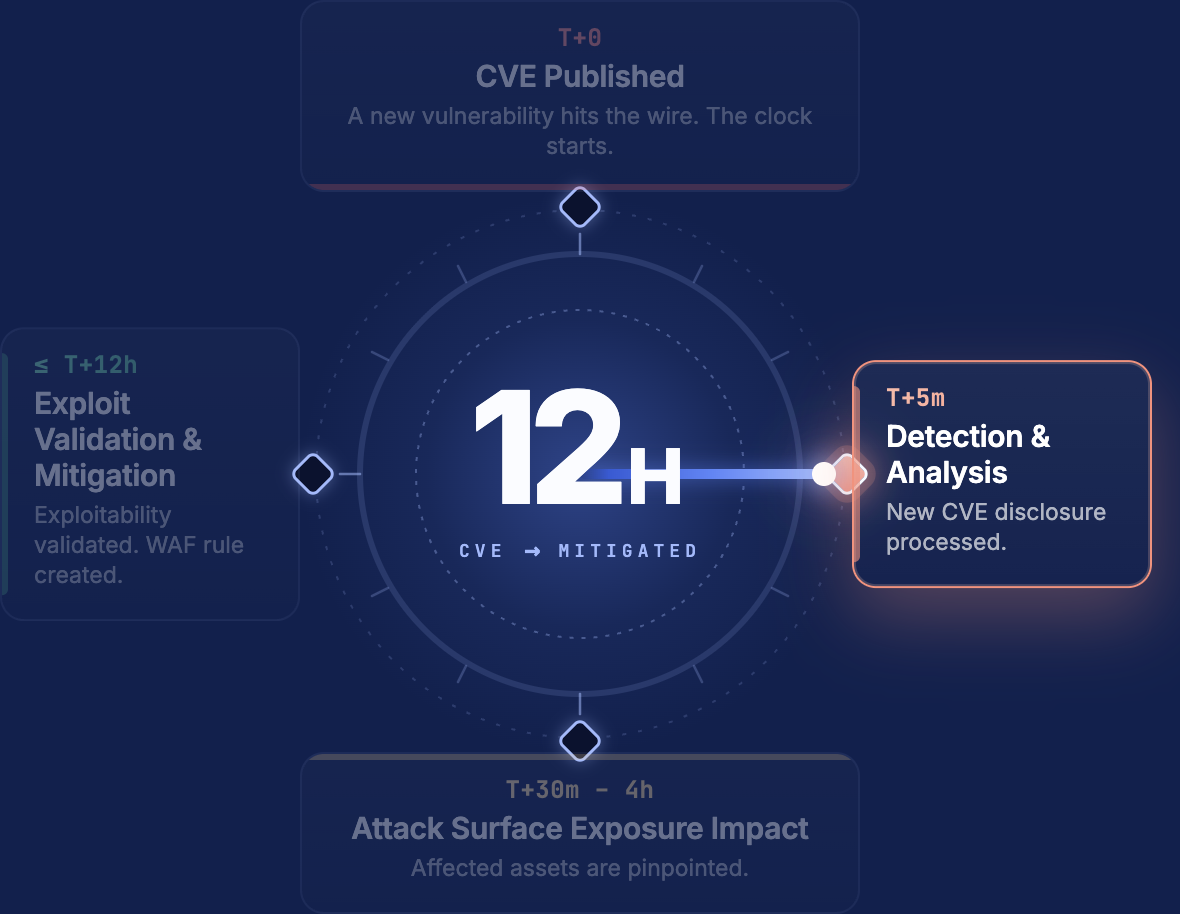



Summary
CVE-2026-64825 is a critical path traversal vulnerability (CWE-22) in Home Assistant Core affecting all versions prior to 2026.6.0. An unauthenticated remote attacker can upload a crafted backup archive during the initial onboarding window to write arbitrary files anywhere on the host filesystem — with full root access when the process runs as root — effectively enabling pre-authentication remote code execution. The vulnerability carries a CVSS v4.0 score of 9.0 (Critical) and a CVSS v3.1 score of 9.3 (Critical).
Technical details
- Root cause: The
namefield inside an uploaded backup archive’sbackup.jsonwas not validated before being passed topathlib.Path.__truediv__. When supplied with an absolute path, Python’spathlibdiscards the configured backup directory prefix entirely, allowing writes to arbitrary filesystem locations. A prior incomplete fix only validated the multipart upload filename, leaving the innerbackup.jsonnamefield unguarded. - Trigger conditions: Exploitation requires the Home Assistant initial onboarding window to be active — i.e., a newly deployed or recently reset instance that has not yet completed first-time setup. During this window, the backup upload endpoint is accessible without authentication.
- Attack vector: Network-accessible HTTP/HTTPS endpoint; no authentication, no user interaction, and no special privileges required.
- Impact: An attacker can write attacker-controlled content to any path on the host filesystem. When Home Assistant runs as root (a common deployment configuration), this translates to full system compromise via techniques such as writing a malicious cron job, injecting an SSH
authorized_keysentry, or planting a systemd unit — achieving remote code execution without any credentials.
Affected software
- Home Assistant Core — all versions prior to 2026.6.0
Severity
- CVSS v4.0: 9.0 Critical —
CVSS:4.0/AV:N/AC:L/AT:P/PR:N/UI:N/VC:N/VI:H/VA:L/SC:N/SI:H/SA:L - CVSS v3.1: 9.3 Critical —
CVSS:3.1/AV:N/AC:L/PR:N/UI:N/S:C/C:N/I:H/A:L
Mitigation and recommended actions
- Immediate: Upgrade to Home Assistant Core 2026.6.0 or later. This release introduces defense-in-depth validation: unsafe
namevalues inbackup.jsonare rejected at parse time, and a secondary filesystem boundary check prevents any write from escaping the backup directory. - If patching is not immediately possible: Restrict network access to the Home Assistant web interface (default port 8123) so that it is not reachable from untrusted networks. Ensure that the onboarding phase is completed as quickly as possible and that the process is not run as root where avoidable.
- Administrators should audit any Home Assistant instances that were recently deployed or reset and were in the onboarding state while internet-exposed, as silent exploitation may have occurred prior to patching.
IONIX Status
The IONIX research team is tracking ongoing exploitation attempts and recommends immediate patching. Potentially affected assets are outlined in this post.