
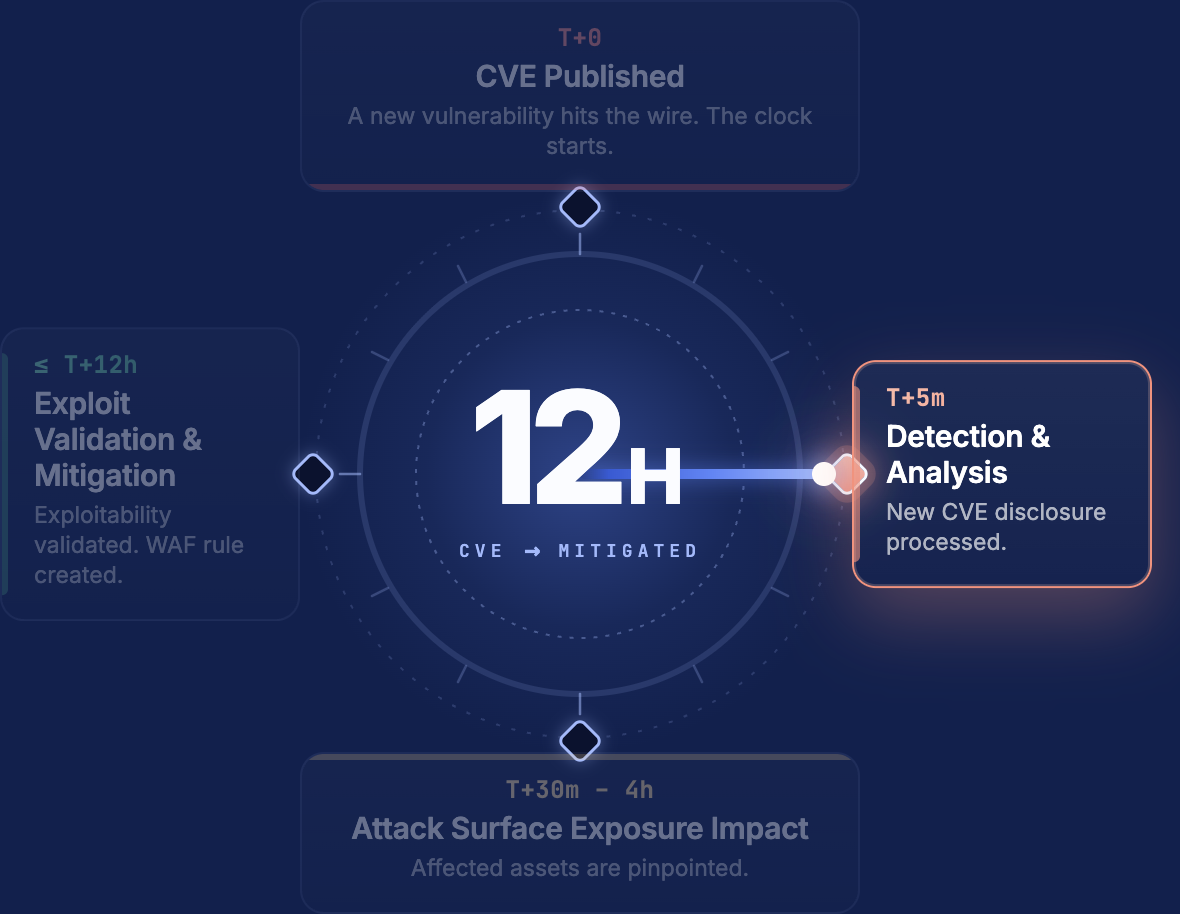


Live Exposure Defense: From CVE to Confirmed Exposure in 12 Hours – See more

New CVE Detected

CVE-2026-74767 – Denial of Service (Decompression Bomb) – Pandora (pandora-analysis) versions 0 thro

Be the first to know when new zero-days emerge:

Summary

CVE-2026-74767 is a denial-of-service vulnerability in Pandora (pandora-analysis), an open-source file analysis framework used to inspect potentially malicious files. The flaw resides in how Pandora’s extractor worker handles DAA (Direct Access Archive) files: internal ISO chunks are decompressed via zlib.decompress() without any limit on the resulting output size. A remote, unauthenticated attacker can submit a specially crafted DAA file to exhaust memory and CPU on the analysis worker, rendering it unresponsive. The issue is rated HIGH severity (8.7).

Technical details

  • Root cause: The DAA extraction routine in pandora/workers/extractor.py decompresses embedded zlib-compressed chunks without enforcing any cap on the decompressed output size.
  • Trigger conditions: An attacker submits a crafted DAA file containing highly compressible data (a "decompression bomb") that expands to a disproportionately large size when decompressed.
  • Attack vector: Network — exploitable via Pandora’s standard file submission/upload workflow with no authentication or user interaction beyond the malicious file upload.
  • Impact: Excessive memory and CPU consumption on the extraction worker, leading to denial of service (worker hangs or becomes unavailable); no direct impact to confidentiality or integrity was identified.

Affected software

  • pandora-analysis / Pandora: versions 0 through 1.12.5 (all releases up to and including 1.12.5)

Severity

  • CVSS Score: 8.7 (HIGH)
  • CVSS v4.0 Vector: CVSS:4.0/AV:N/AC:L/AT:N/PR:N/UI:N/VC:N/VI:N/VA:H/SC:N/SI:N/SA:L
  • Network attack vector, low attack complexity, no privileges or user interaction required, high impact to availability, no impact to confidentiality or integrity.

Mitigation and recommended actions

  • Immediate: Upgrade to the patched release of Pandora that includes bounded decompression for DAA file handling (fix introduced in commit f4294a873f86fbf2569c289e329fff2f52ca50c9, which adds a ZipBomb exception and enforces a max_extracted_filesize limit — default 500,000,000 bytes — during decompression). Confirm the deployed version is beyond 1.12.5 and includes this fix.
  • If patching is not immediately possible:
    • Restrict or disable DAA file submission/processing in Pandora until patched.
    • Apply resource limits (memory/CPU quotas, container cgroup limits) on extraction worker processes to constrain the impact of a decompression bomb.
    • Monitor extraction worker resource usage and configure alerting for abnormal memory/CPU spikes correlated with file submissions.
    • Restrict network exposure of the Pandora submission interface to trusted networks where feasible.

References

Are you exposed?

Get a free report of your organization’s exposure to this CVE and threat

How IONIX’s External Exposure Management Platform Detects and Validates
Zero-Days to Shrink MTTR

1

Map your entire attack surface (continously)

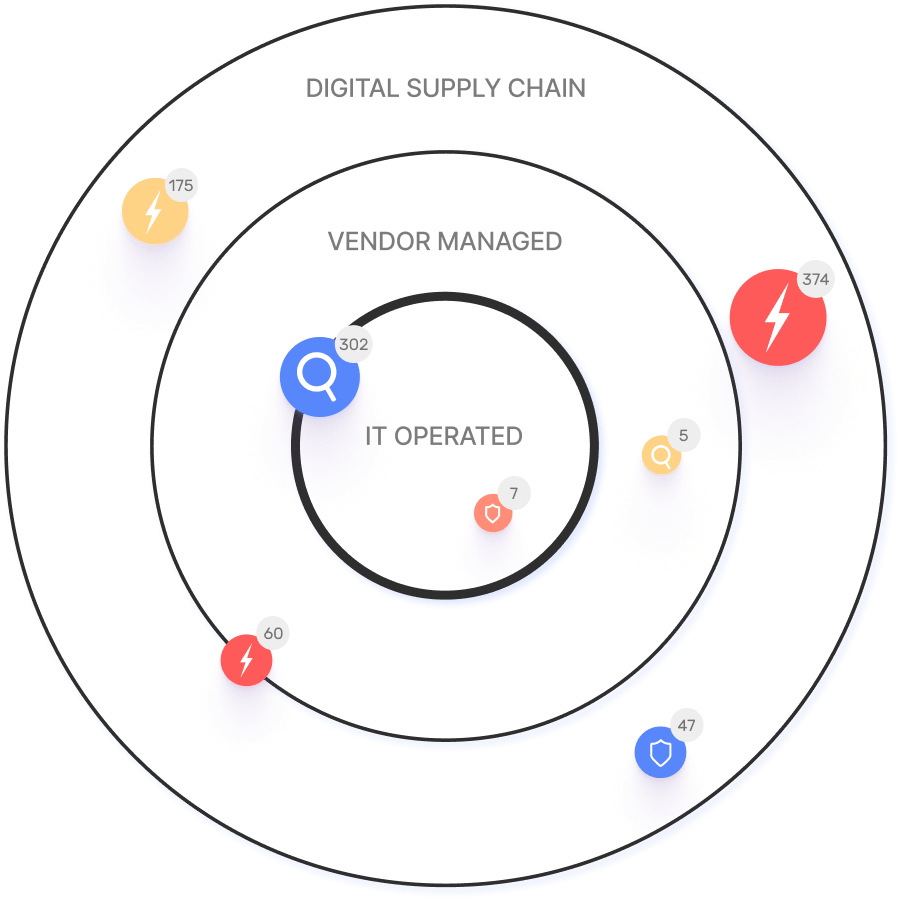
IONIX uses multi-factor discovery methods, including DNS analysis, certificate mapping, metadata inspection, and more, to automatically map every internet-facing asset across your environment. This includes cloud instances, third-party platforms, shadow IT, and even forgotten infrastructure that traditional tools miss.

2

Monitor for new CVEs

Dozens of threat intel feeds using agentic technology are continuously analyzed to detect the appearance of proof-of-concept code, exploit kits, and indicators of active targeting. IONIX goes further by applying AI to proactively evaluate whether emerging vulnerabilities are likely to be exploited, even before PoCs go public.

3

Identify Potential External Exposures

Not all CVEs matter. IONIX filters vulnerabilities by asking attacker-centric questions: Can it be reached from the internet? Does it require authentication? Is it being exploited in the wild? This dramatically reduces noise and focuses teams on threats that can actually be weaponized.

4

Create Safe, Scalable Exploit Validations

IONIX transforms real-world PoCs into safe, non-intrusive test payloads that can be run in production environments without disruption. These simulations are precisely targeted to the systems that are vulnerable, ensuring rapid validation without unnecessary load.

5

Execute Exploit Validations

By combining context about software stack, versioning, exposure status, and reachability, IONIX ensures that only the right payloads are executed against the right assets, maximizing efficiency and minimizing risk.

6

Drive Fast and Actionable Remediation

Results are routed through integrations with ticketing, SOAR, and SIEM tools. Issues are written in plain language, bundled into remediation clusters, and prioritized based on asset criticality, exploitability, and blast radius. This shortens mean time to remediation (MTTR) and empowers teams to act with confidence.

Are you exposed?

Get a free report of your organization’s exposure to this CVE and threat

Subscribe to Threat Center RSS

Copy/paste the link below into your preferred RSS reader or follow these instructions to subscribe to Slack alerts.

Get Real-Time CVE Alerts to Your Email

Be the first to know when new zero-days emerge