



Summary
CVE-2026-9725 is a critical unauthenticated arbitrary file deletion vulnerability affecting the Printcart Web to Print Product Designer for WooCommerce WordPress plugin in all versions up to and including 2.5.2. The flaw allows any unauthenticated remote attacker to delete arbitrary files on the server — an impact class that the CVE advisory explicitly notes may make remote code execution possible. With a CVSS v3.1 base score of 9.1, the vulnerability requires no privileges and no user interaction to exploit.
Technical details
- Root cause: The
store_design_data()function constructs a server-side filesystem path from the user-suppliednbd_item_keyPOST parameter. The parameter is passed throughsanitize_text_field()only, which does not strip path traversal sequences (../). The resulting unsanitized path is passed directly toNbdesigner_IO::delete_folder()and PHP’srename(), giving an attacker full control over which directory is deleted or renamed. - Authentication bypass: The WordPress nonce that nominally protects the
nbd_save_customer_designAJAX action is freely obtainable by unauthenticated users via thenbd_check_use_logged_inendpoint, eliminating any authentication barrier. - Attack vector: Remote, unauthenticated HTTP POST request to the WordPress AJAX endpoint. No prior access or credentials required.
- Impact: Arbitrary deletion of files and directories on the server via path traversal. Deletion of critical WordPress files such as
wp-config.phpor.htaccessis a well-established pathway to subsequent remote code execution. CVSS impact metrics: Integrity — High, Availability — High.
Affected software
- Printcart Web to Print Product Designer for WooCommerce (WordPress plugin slug:
printcart-integration), all versions up to and including 2.5.2
Severity
- CVSS v3.1 Base Score: 9.1 (Critical)
- Vector String:
CVSS:3.1/AV:N/AC:L/PR:N/UI:N/S:U/C:N/I:H/A:H
Mitigation and recommended actions
- Immediate action — apply the patch: Upgrade to version 2.5.3 (released July 2, 2026), which resolves CVE-2026-9725 by introducing a new
nbd_sanitize_item_key()helper that strips path-traversal sequences and restricts the design-folder key to the[A-Za-z0-9_-]character set used by legitimate keys. All input sites constructing filesystem paths fromnbd_item_keyand related parameters across the plugin codebase have been hardened in this release. - If immediate patching is not possible: Restrict unauthenticated access to WordPress AJAX endpoints (
/wp-admin/admin-ajax.php) at the network perimeter or web application firewall level as a temporary measure. This does not fully mitigate the vulnerability since AJAX access is required for normal plugin functionality.
IONIX Status
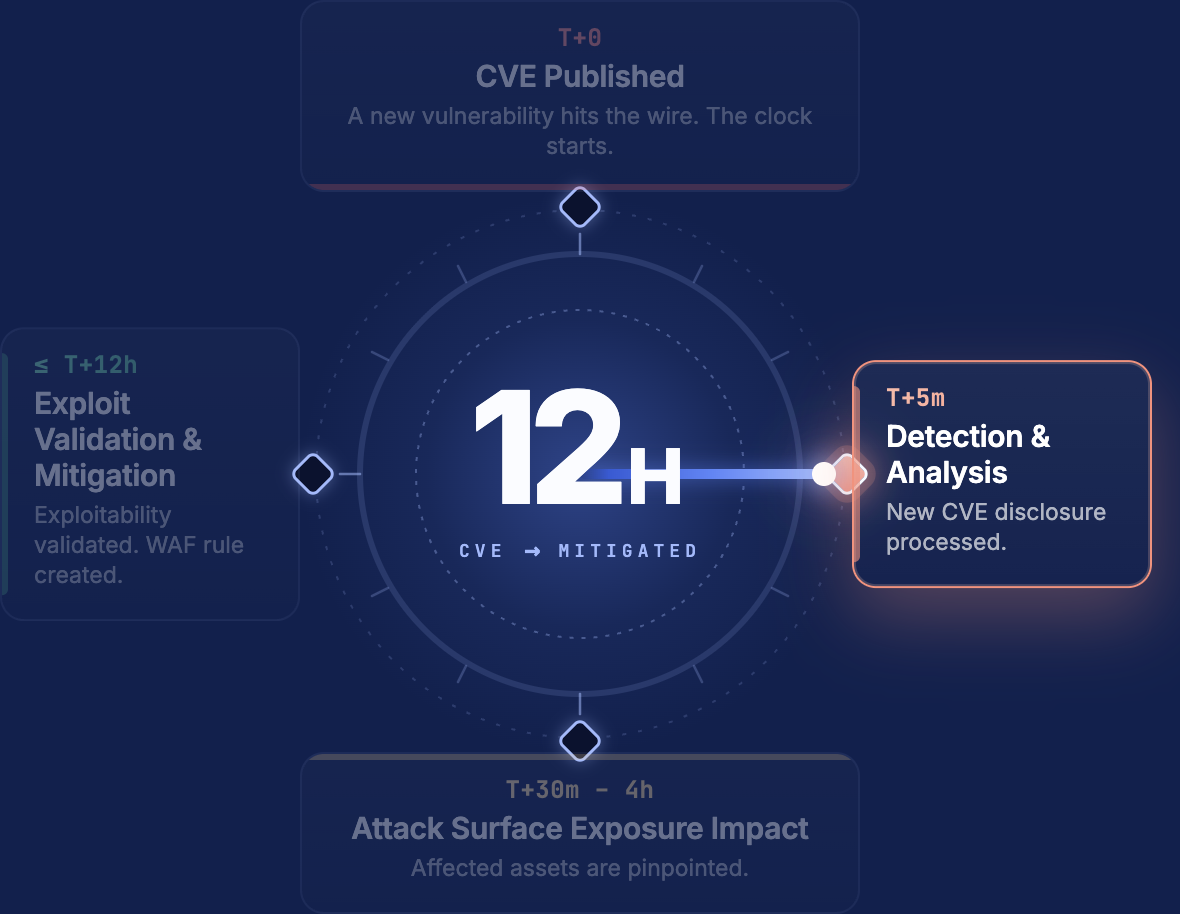
The IONIX research team is tracking ongoing exploitation attempts and recommends immediate patching. Potentially affected assets are outlined in this post.