
Automated Penetration Testing: How Continuous, AI-Driven Testing Validates Real Exposures


Automated penetration testing is the use of software to find, exploit, and chain weaknesses in live systems, then prove each result with evidence. It attacks the way an outsider would, on a schedule or after each release instead of once a year. The buyer’s question is which parts of the manual test it can take over, and which it can’t.
Key Takeaways about Automated Penetration Testing
- Automated penetration testing covers breadth, cadence, and retesting. It can rerun the same exploit chain after each weekly release, which an annual engagement scoped months earlier cannot do.
- Human testers still own business logic flaws, GUI-heavy workflows, and the final call on anything an automated or AI-driven tool reports as exploitable.
- In a December 2025 study by Stanford, Carnegie Mellon, and Gray Swan AI researchers, the ARTEMIS agent outperformed 9 of 10 professional pentesters. The AI agents also showed higher false-positive rates than the humans.
- An external test only reaches assets on its target list. Feed that list from continuous discovery, or the test will miss the microsite an agency launched last month.
This guide takes the attacker’s view from outside and measures AI testing against published, vendor-neutral research. It also separates two jobs that get blurred: testing the assets you know about and finding the ones your scope left out. Breach and attack simulation, which checks internal controls and detection rules, is a separate discipline.
What Is Automated Penetration Testing?
Automated penetration testing runs attack techniques against live targets and keeps going after the first finding. A tool discovers a weakness, attempts to exploit it, and uses what it gains to reach the next step, recording proof at each stage. A scanner stops at step one.
The reference methodology is older than the tooling. NIST SP 800-115, the Technical Guide to Information Security Testing and Assessment, dates to September 2008, and NIST has not revised it since. Its four phases (planning, discovery, attack, and reporting) still define what a penetration test covers, and they assume a human team working a fixed engagement.
Automation compresses those phases into a loop that can run weekly or after each deploy. A finding still means a weakness the tool exploited, with evidence a developer can reproduce. For where this sits next to dynamic application testing and attack surface management, read the breakdown of pentest vs DAST vs ASM.
Automated vs Manual Penetration Testing: What Each Does Best
The automated vs manual penetration testing decision comes down to breadth against depth. Automation repeats known attack paths across many assets at a steady cadence. A human tester reads the application, forms a theory about how its business rules break, and tests that theory.
Both go further than a scanner, which stops at detection. The guide to vulnerability scanning vs penetration testing draws that line. The table below compares manual vs automated penetration testing on the points buyers have to defend to leadership and auditors.
| Dimension | Automated testing | Manual testing |
|---|---|---|
| Coverage breadth | Hundreds or thousands of hosts and apps per run | The hosts and apps named in the statement of work |
| Depth and business logic | Known techniques and chains; weak on logic flaws such as price manipulation or self-approval | Strong: testers reason about roles, workflows, and intent |
| Cadence | Weekly, daily, or on each release | Annual, or after a major change on the engagement calendar |
| Retesting | Reruns the exact chain on demand after a fix | A separate, scheduled retest window |
| Cost model | Subscription or per-asset license | Per engagement, priced by tester days |
| False positives | Higher for AI agents (ARTEMIS study, 2025); varies by tool | Lower, because testers confirm before they report |
| Compliance acceptance | Supports the test but does not satisfy PCI DSS 11.4 alone; PCI SSC guidance says running an automated tool is not enough | Meets PCI DSS 11.4 when a qualified, independent tester follows a defined methodology |
| Finds assets outside the agreed scope | Only when paired with continuous discovery; testing alone is limited to its target list | No, testers stay inside the signed scope |
Use automation for the internet-facing estate that changes every week and for retesting fixes between engagements. Use human testers for new applications with complex roles, for payment and approval flows, and for the annual report an assessor will read.
Neither replaces the other. Running both lets automation hand the human team a shorter, better-targeted scope.
Continuous Penetration Testing: From Annual Reports to Always-On Validation
Continuous penetration testing runs automated attack paths on a schedule tied to change, so each finding reflects this week’s code. The annual report stays, as one checkpoint among many.
Compliance sets the floor. PCI DSS v4.0.1 Requirement 11.4 covers internal and external penetration tests. Both run "at least once every 12 months and after any significant infrastructure or application upgrade or change."
Service providers that use segmentation to isolate cardholder data must test those controls at least every six months. Requirement 11.4.4 adds that teams correct exploitable findings and repeat the test to verify the corrections.
The second half of that cadence clause is where annual testing breaks. Take app.example.com and api-v2.example.com, a customer portal and its API that ship every Friday. Commissioning a manual test after each of 52 releases a year is unrealistic, so the "after any significant change" clause goes unmet.
An automated test can rerun the same attack chain after each release. The chain starts at an exposed /admin path on app.example.com, where default credentials still work. It ends at a data-access endpoint on api-v2.example.com that trusts the admin session.
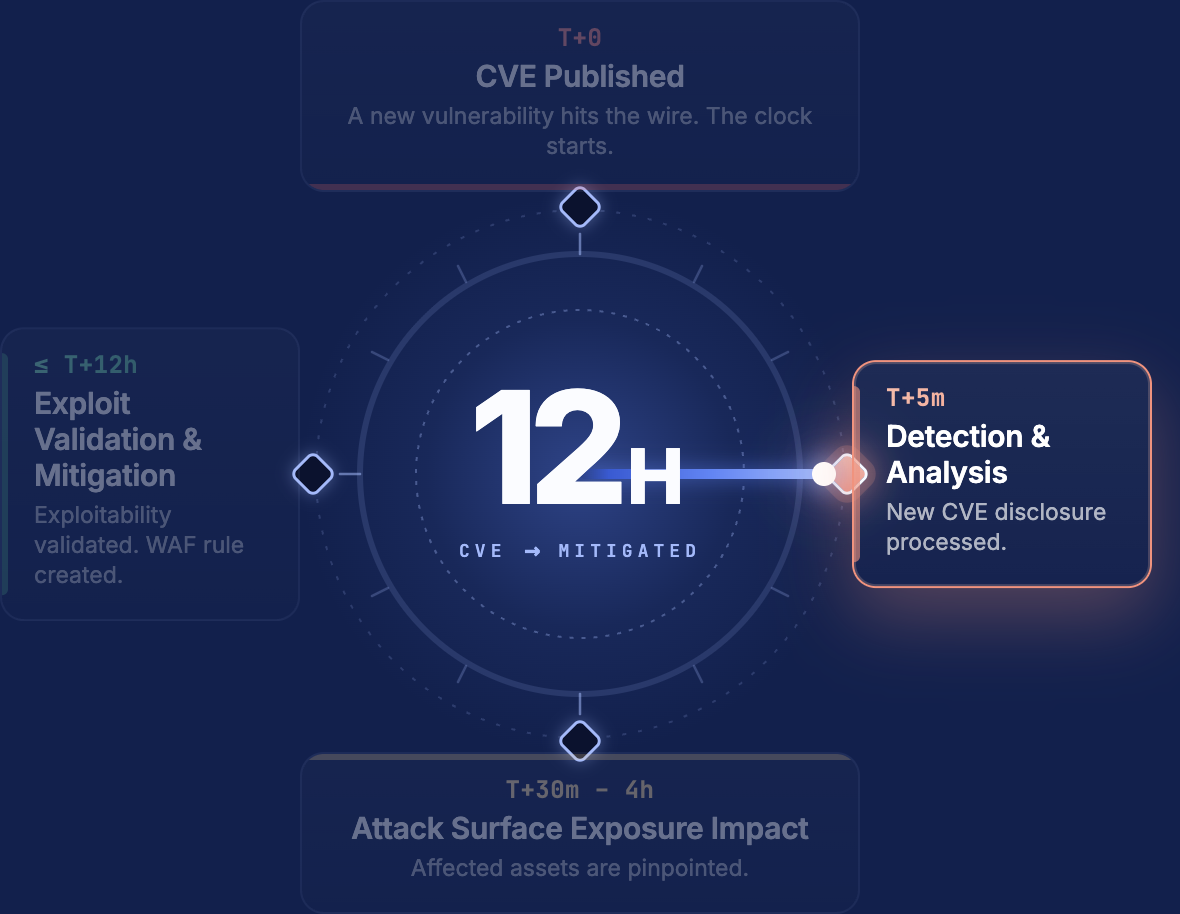
If a Friday release puts the path back or resets the credentials, the next run flags it that weekend.
External Penetration Testing: Testing Your Attack Surface the Way Attackers See It
External penetration testing attacks internet-facing assets from outside the network, with no credentials or internal foothold. Scope is its weak point: a pentest is generally only as complete as the target list it starts from. IONIX takes a different approach by starting without a predefined asset list, continuously discovering the organization’s external landscape and surfacing internet-facing assets and exposures the security team may not know exist.
Suppose a marketing agency launches spring-offer.example.com on a third-party host for a campaign. The site skips the asset inventory, so it skips the pentest scope, and its content management plugin goes unpatched. An attacker probing example.com finds it; the scoped test does not look.
Outside-in testing backed by continuous discovery closes that gap. Rather than relying on a predefined asset list, discovery maps domains, cloud services, and third-party hosts tied to the organization, including assets the security team did not know to put in scope. Testing can then follow the discovered attack surface instead of a spreadsheet from last year’s scoping call.
The assets that drop out of scope tend to sit at subsidiaries, acquired companies, and agencies, far from the primary domain.
Reachability is the test that counts here. An asset that answers from the internet is in the attacker’s scope, whatever the statement of work says. The case for testing from the outside rests on proving reachability from the internet, because configuration data alone can mislead.
AI Penetration Testing: What Agentic Testing Can (and Can’t) Do in 2026
AI penetration testing uses large language model (LLM) agents to plan and run attack steps, choosing each action from what the last one returned. The strongest neutral evidence comes from a live-network study and a government competition.
In a study first published in December 2025, researchers from Stanford, Carnegie Mellon, and Gray Swan AI built a multi-agent framework called ARTEMIS. They tested it against 10 professional pentesters and 6 existing AI agents on a university network of about 8,000 hosts across 12 subnets.
The best ARTEMIS configuration placed second overall, found 9 valid vulnerabilities with an 82% valid submission rate, and outperformed 9 of the 10 humans. One human tester still finished first. Some ARTEMIS variants cost $18 an hour, against $60 an hour for the professional testers.
DARPA’s AI Cyber Challenge (AIxCC) measured a different job. In the August 2025 final, autonomous systems analyzed 54 million lines of code, found 54 of 63 synthetic vulnerabilities (86%), and patched 43. They also found 18 real vulnerabilities that organizers had not planted, patched 11, and spent about $152 per task.
AIxCC scored systems on source code in a competition setting. Its results speak to AI-assisted code review more than to attacks on a running network.
The limits are specific. The ARTEMIS authors report that AI agents produced more false positives than the human testers and struggled with tasks that needed a graphical interface. Treat an agent’s finding as a lead until a person or a deterministic check reproduces it.
Agents that handle discovery and mitigation solve a different problem, covered in the piece on agentic EASM at machine speed.
Automated Pentesting Tools: Evaluation Criteria
Automated pentesting tools range from scripted exploit frameworks to AI agents. Their demos look alike.
The questions below follow the order a buyer meets the problem: safety first, proof second, operations last. Ask each vendor for evidence from a real run.
- Can the tool run against production without changing data or taking a service down, and which techniques does it disable by default?
- Does each finding include proof of exploitation, such as the request, the response, and the data reached, that a developer can reproduce?
- Can it chain findings, for example an exposed admin path to default credentials to a data endpoint, and show the full path in one record?
- Does its target list come from continuous discovery of internet-facing assets, or from a file someone uploads once a quarter?
- Can it retest a single finding on demand after a fix, and close the finding when the exploit fails?
- Does it push validated findings into Jira or ServiceNow with the asset owner, the evidence, and the fix guidance attached?
- What share of its findings does a human confirm, and can the vendor show that rate from a production deployment?
- Can it export the method, scope, dates, and retest results an assessor asks for under PCI DSS 11.4?
A tool that can’t answer the first two questions with evidence is a vulnerability scanner under a new name.
Turning Test Findings Into Fixes
A finding from an automated penetration testing run pays off once someone fixes it and a retest proves the fix. The handoff needs the asset owner, the evidence of exploitation, and the specific change that breaks the chain. Findings without an owner sit in a queue.
Break the chain at its cheapest link first. In the example estate, rotating the default credentials on app.example.com stops the attack the same day. Removing the /admin exposure and the API’s trust in admin sessions goes to the development backlog.
The automated test then reruns the chain and confirms it no longer completes. If the code fix takes weeks, a web application firewall (WAF) rule on the admin path acts as a compensating control. It closes the exposure window while the patch queue catches up.
Automation earns its place on coverage and on the retest after each fix. Human testers keep business logic and the final call on AI findings. An external test stays only as good as the asset list behind it.
IONIX works on the external slice of this problem. Its continuous discovery maps internet-facing assets across subsidiaries, acquisitions, and third-party hosts without relying on a predefined pentest scope, including assets the organization may not know are exposed. Non-intrusive exploit simulations then confirm which exposures an attacker can use, and validated findings move to mitigation and remediation with the evidence attached.
IONIX provides continuous external exposure validation, which is narrower than a full pentest. It does not replace a scoped manual test for business logic or internal networks.
Teams that want the outside-in half running between engagements can start with continuous exposure validation and route results through accelerated remediation workflows. Book a demo to see how IONIX validates exploitable exposures across your internet-facing attack surface.
FAQs about Automated Penetration Testing
It can be, if the tool limits itself to non-destructive proof by default. Ask the vendor which techniques it disables in production, how it throttles requests, and how it removes test accounts or files. Run the first cycles in a maintenance window, then widen the schedule once the operations team trusts the results.
Not on its own: the PCI SSC’s 2017 Penetration Testing Guidance states that running an automated tool does not satisfy the requirement. PCI DSS 11.4.2 and 11.4.3 call for a qualified, independent tester following a defined methodology. Automated penetration testing output can support that test once the tester interprets the results and signs the report.
Match the cadence to the rate of change. Internet-facing apps that ship weekly justify a weekly run plus a targeted rerun after each release, while stable infrastructure can run monthly. Retest individual findings on demand after each fix, because that is where automation saves the most time over booking another manual engagement.
Rarely, and not reliably. A flaw such as applying one discount twice or approving your own expense report depends on knowing what the application is supposed to do. Ask any vendor that claims otherwise to show it on one of your own workflows, and keep human testers on those flows.
Yes: treat an automated test like any penetration test, with written authorization from the asset owner and agreed rules of engagement. Check the testing policy of each cloud or hosting provider involved, too. Assets found outside the agreed scope, such as an agency-run microsite, need the owner’s sign-off before anyone tests them.
Sources
- Lin, J. W., et al., "Comparing AI Agents to Cybersecurity Professionals in Real-World Penetration Testing," arXiv:2512.09882 (2025, revised 2026). https://arxiv.org/abs/2512.09882
- DARPA, AI Cyber Challenge (AIxCC) final competition results, news release (August 8, 2025). https://www.darpa.mil/news/2025/aixcc-results
- PCI Security Standards Council, "PCI DSS v4.0.1" (June 2024). https://www.pcisecuritystandards.org/document_library/
- PCI Security Standards Council, "Information Supplement: Penetration Testing Guidance," v1.1 (September 2017). https://www.pcisecuritystandards.org/documents/Penetration-Testing-Guidance-v1_1.pdf
- NIST, "SP 800-115, Technical Guide to Information Security Testing and Assessment" (2008). https://csrc.nist.gov/pubs/sp/800/115/final