
Best Shadow IT Discovery and Subsidiary Risk Tools in 2026


An attacker mapping your organization does not start with your primary domain. They start with the subsidiary you acquired two years ago, the marketing microsite a regional team spun up without telling IT, the forgotten staging server that still resolves. Shadow IT and subsidiary sprawl are where breaches begin, because they are the assets your scanners were never pointed at. Choosing the best shadow IT discovery tool for 2026 comes down to one question: can the platform figure out what your organization actually owns before it starts scanning?
Most platforms cannot. They discover assets, then try to attribute ownership after the fact. That works for the infrastructure you already know about. It fails for the entities you forgot, the brands a subsidiary registered, and the acquisitions that never got folded into your security program. This roundup evaluates the platforms enterprises shortlist for shadow IT detection and subsidiary risk management, and explains why organizational research, not port volume, decides which tool actually closes the gap.
Why shadow IT and subsidiary risk break the same way
Shadow IT is any technology your security team does not know about: unsanctioned SaaS, rogue cloud instances, forgotten subdomains, exposed APIs. Subsidiary risk is the same problem at corporate scale. An acquired company arrives with its own domains, cloud accounts, and vendor relationships, and most of it never reaches the parent’s asset inventory.
The numbers make the stakes concrete. According to Enterprise Strategy Group research published in 2023, 76% of organizations experienced a cyberattack that exploited an unknown, unmanaged, or poorly managed internet-facing asset, and nearly half reported multiple such attacks. Attackers moved faster to exploit these gaps: Verizon’s 2024 Data Breach Investigations Report found a 180% increase in breaches that began with vulnerability exploitation, with web applications as the main entry point. Shadow spending compounds the visibility problem. Gartner has estimated for years that shadow IT accounts for 30 to 40% of IT spending in large enterprises, which means a large share of your technology footprint sits outside the systems meant to secure it.
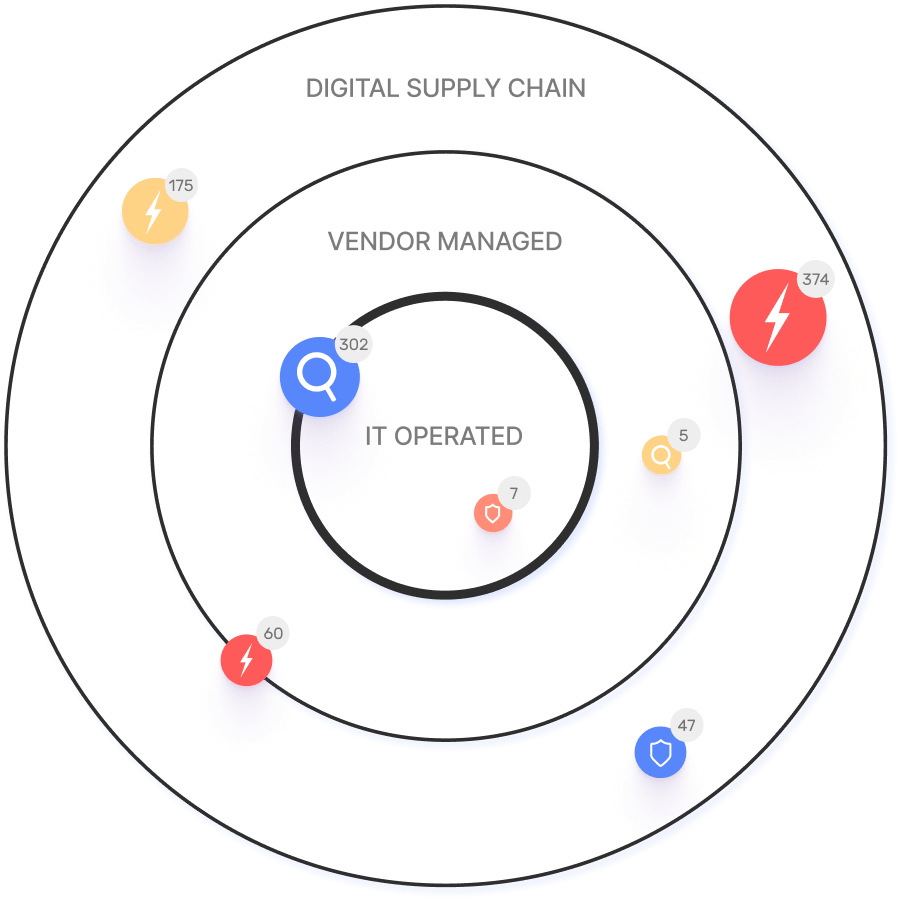
Both problems share a root cause. A discovery tool that starts from a seed list of known domains, or that infers ownership from algorithmic signals, finds assets it can already connect to something. It misses the entity it never knew existed. IONIX research on multi-entity organizations found that enterprises average 204 subsidiaries. That is 204 potential blind spots, and the discovery approach determines how many of them the platform can actually find and attribute.
How to evaluate a shadow IT and subsidiary risk platform
For shadow IT discovery and subsidiary risk management, five criteria separate a tool that finds assets from a tool that finds the right assets and ties them to the right entity.
Organizational entity mapping. Does the platform build a structured model of your corporate structure, including subsidiaries, acquisitions, and brand registrations, before it scans? Or does it start from assets it can already see and guess at ownership afterward? This is the criterion that decides whether unknown entities stay hidden.
Non-intrusive assessment. Can the platform assess a subsidiary’s exposure without requiring that subsidiary to install anything, grant credentials, or cooperate? Recently acquired companies rarely cooperate on day one. External assessment that needs no agent and no permission is the only approach that covers them from the start.
Subsidiary benchmarking and portfolio dashboards. Can a parent-company security team see exposure broken out by entity, compare subsidiaries against each other, and track each one over time? A single flat list of assets does not answer the questions a portfolio owner asks.
Digital supply chain coverage. Does the platform trace risk into the third-party scripts, infrastructure, and dependencies your applications rely on? Subsidiaries inherit supply chain exposure the parent never approved.
Validated exploitability. Once an asset is found, does the platform confirm it is reachable and exploitable from the outside, or does it hand you a longer worry list? Discovery without validation produces volume. Validation produces action.
IONIX: organizational research first, then discovery and mitigation
IONIX is a Preemptive Exposure Mitigation platform built for exactly the profile this article describes: enterprises with subsidiaries, acquisitions, and extended supply chains. It inverts the usual discovery sequence. Before scanning a single asset, IONIX maps the full organizational picture, covering subsidiaries, acquisitions, and affiliated brands, then discovers and validates within that scope. This is Exposure by Association, and it is the reason IONIX finds the subsidiary a seed-based tool never scopes.
Against the five criteria:
- Organizational entity mapping: IONIX builds a verified corporate entity model first. Most tools find the assets you know about. IONIX starts by figuring out what you own, including what you forgot you owned.
- Non-intrusive assessment: IONIX assesses external exposure without agents, credentials, or subsidiary cooperation, so a company acquired last quarter is in scope immediately.
- Subsidiary benchmarking and portfolio dashboards: IONIX presents exposure by entity, so a parent team can compare subsidiaries and track each one, which is how holding companies and multi-brand enterprises actually operate.
- Digital supply chain coverage: Connective Intelligence traces risk through the third-party dependencies embedded in your external exposure, including script inclusions and third-party infrastructure.
- Validated exploitability: IONIX confirms real-world exploitability with active, non-intrusive testing, then mitigates. Customers report a 90% reduction in mean time to resolve external exposures and a 97% drop in false-positive alerts. One Fortune 500 organization cut MTTR by more than 80% within six months.
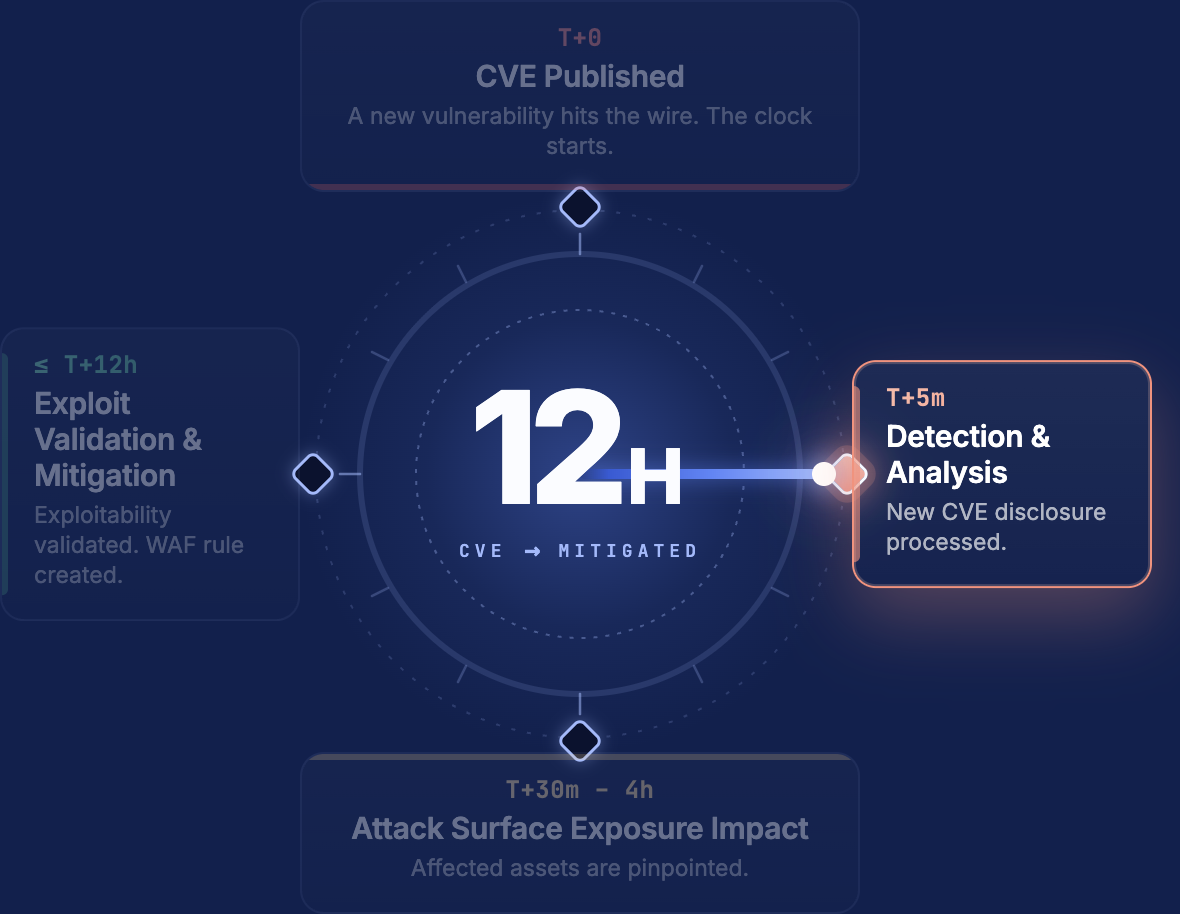
IONIX runs across the full CTEM lifecycle, from discovery through validation and mitigation. When a new CVE drops, Live Exposure Defense commits to a 12-hour SLA from publication to identifying every affected asset, validates exploitability inside that window, and recommends the WAF rule to close it. Most vendors send you a list. IONIX sends you the validated, exploitable assets and the rule to mitigate them.
CyCognito: algorithmic attribution without organizational research
CyCognito is the most direct competitor in this category and leads with “zero-input” seedless discovery. Its algorithm attributes assets to an organization by inferring ownership from signals across the internet. This is a genuine capability, and CyCognito has real market presence and Gartner recognition.
The distinction matters for subsidiary use cases. CyCognito infers which assets belong to you. It does not build a structured organizational entity model from corporate records, M&A history, and brand registrations. When ownership signals are weak, such as a recently acquired subsidiary that has not yet been rebranded or reintegrated, algorithmic attribution can miss the connection. IONIX maps the corporate structure first, so those entities are in scope by design rather than by inference.
On validation, both platforms test exposures. Ask whether that validation extends to subsidiary and supply chain assets or only to directly-owned infrastructure, and ask what the platform does after it confirms an exposure. IONIX hands your team the deployable WAF rule.
Cortex Xpanse: port scanning at scale without entity mapping
Palo Alto’s Cortex Xpanse scans at massive volume, on the order of hundreds of billions of ports daily, and suits enterprises consolidating on the Cortex platform. Palo Alto has also positioned recent Cortex releases as reducing the need for standalone external attack surface management tooling.
Scale is not the constraint most subsidiary programs face. Xpanse starts from internet-visible assets and does not conduct structured organizational research to build a complete entity model before discovery. Assets belonging to unknown subsidiaries or recent acquisitions get missed, because port volume finds what is visible, not what belongs to an entity you never scoped. An add-on that bolts external scan data onto an XDR platform does not replace organizational research, active exploitability validation, and supply chain mapping. Those are the gaps where subsidiary breaches start.
Censys: internet intelligence, not organizational scoping
Censys is a strong internet intelligence layer, prized by researchers and other vendors for the breadth of its passive scanning data. For organizations that need raw internet data, it delivers.
It is not built to scope a specific organization. Censys scans the internet broadly and cannot derive which assets belong to your subsidiaries and acquisitions. It provides data for analysis, not an operational path from discovery through validation to mitigation. For a subsidiary risk program that needs to attribute assets to entities and act on findings, passive internet data is a starting point, not an answer. Censys shows what exists on the internet. IONIX shows what is exploitable in your environment.
Tenable: vulnerability management extended outward
Tenable One extends a vulnerability management foundation outward and carries real weight in enterprise procurement, including Gartner recognition and a broad integration ecosystem.
That heritage shapes what it covers. Tenable’s scanners cover the assets you point them at. For shadow IT and unknown subsidiaries, the assets you cannot point at are the whole problem. Tenable frames its AI as smarter prioritization and scoring rather than active exploitability validation, and subsidiary and supply chain scope is not a lead capability of the platform. IONIX is built from the outside in: organizational entity mapping, then discovery, then active validation, then mitigation. Tenable’s scanners cover the assets you name. IONIX finds the ones you cannot name.
Platform comparison at a glance
| Criterion | IONIX | CyCognito | Cortex Xpanse | Censys | Tenable |
|---|---|---|---|---|---|
| Organizational entity mapping | Structured model built before scanning | Algorithmic inference | Starts from internet-visible assets | Not organization-scoped | Seed and scanner-based |
| Non-intrusive subsidiary assessment | Yes, no cooperation required | Yes | Yes | Data layer only | Scanner-dependent |
| Subsidiary benchmarking dashboards | Yes, exposure by entity | Partial | Not a lead capability | No | Not a lead capability |
| Digital supply chain coverage | Yes, Connective Intelligence | Not a lead capability | Not a primary capability | No | Not a lead story |
| Validated exploitability | Active, non-intrusive validation | Validation on owned infrastructure | Reports what exists | Passive data only | Prioritization and scoring |
Buyer guidance: start with organizational research
Shadow IT discovery and subsidiary risk management require organizational research as the foundation. Without it, a platform finds assets but cannot reliably tie them to the right entity, and it cannot find entities it does not already know about. Every downstream capability, validation, benchmarking, supply chain tracing, depends on getting the scope right first.
If your organization has grown through acquisition, operates multiple brands, or manages a portfolio of subsidiaries, weight organizational entity mapping above raw scanning scale. A tool that scans hundreds of billions of ports but starts from a seed list will still miss the subsidiary you forgot you owned. A tool that maps your corporate structure first will find it, validate whether its exposure is exploitable, and give your team the rule to close it.
That is the case for IONIX in complex, multi-entity environments. It maps what you own, validates what an attacker can reach, and mitigates what it confirms. Book a demo to see it run against your own organizational footprint.
FAQs
The best shadow IT discovery tool is one that maps your organizational structure before it scans, so it can find assets tied to subsidiaries and acquisitions you may have forgotten. IONIX builds a verified corporate entity model first, then discovers and validates internet-facing assets within that scope. Tools that start from a seed list or infer ownership algorithmically tend to miss entities they do not already recognize.
For subsidiary risk across a global enterprise, look for organizational entity mapping, non-intrusive assessment that needs no subsidiary cooperation, per-entity benchmarking dashboards, and validated exploitability. IONIX is purpose-built for multi-entity organizations and covers all four, mapping the full corporate structure, then validating and mitigating exposure across subsidiaries and supply chain.
Scanning scale tells you how many assets a platform can process, not whether it knows which assets belong to your organization. A platform can scan billions of ports and still miss a subsidiary it never scoped. Organizational research maps corporate structure, M&A history, and brand registrations first, so discovery starts from a complete entity model rather than a list of known domains.
External assessment platforms evaluate exposure from the attacker’s perspective, so they do not require a subsidiary to install agents or grant credentials. This matters most for recently acquired companies that have not been integrated into the parent’s security program. IONIX assesses newly acquired entities from day one without any cooperation from the subsidiary.
Attackers exploit new vulnerabilities within hours of disclosure, so a security team needs to know which of its assets are affected in hours, not weeks. IONIX Live Exposure Defense commits to a 12-hour SLA from CVE publication to identifying every potentially affected asset, validates exploitability inside that window, and recommends a mitigation.