
EASM for Financial Services: What Banking Security Teams Should Evaluate in 2026


Financial services institutions face a regulatory environment that now treats external exposure as a compliance failure. DORA took effect in January 2025. PCI-DSS 4.0 became mandatory in March 2025. Both regulations require continuous monitoring of internet-facing assets, third-party risk oversight, and documented evidence that your security team identified and addressed exposures before an attacker did. IONIX customers report a 90% reduction in mean time to resolve external exposures and a 97% drop in false-positive alerts, outcomes that map to what these regulations demand.
Banks, insurers, and payment processors cannot rely on EASM tools built for asset discovery alone. Regulators expect validated exposure data across subsidiaries, acquired entities, and digital supply chains. This article examines what DORA and PCI-DSS 4.0 require from an External Exposure Management platform and which capabilities banking security teams should prioritize when evaluating tools.
DORA and PCI-DSS 4.0 raised the bar for external exposure management
DORA (the Digital Operational Resilience Act) applies to banks, insurance companies, payment institutions, and their ICT service providers across all 27 EU member states. Its five pillars cover ICT risk management, incident response, resilience testing, third-party risk oversight, and threat intelligence sharing. Two requirements have direct implications for EASM tool selection:
- Third-party ICT risk management. DORA requires financial entities to assess, monitor, and mitigate risks across their full digital supply chain, including subcontractors of their service providers. According to PwC’s 2025 analysis of DORA’s third-party risk provisions, contracts with ICT providers must include provisions for monitoring, access rights, and exit strategies. An EASM tool that discovers assets on your primary domain but ignores your payment processor’s exposed infrastructure leaves a regulatory gap.
- Resilience testing. DORA mandates threat-led penetration testing (TLPT) for critical entities, with the first round due by January 2026. Continuous exposure validation feeds directly into these testing requirements by identifying where external-facing weaknesses exist before pen testers arrive.
PCI-DSS 4.0 adds complementary pressure. Requirement 11.3.1.1 now mandates that organizations manage all discovered vulnerabilities, not just those ranked as high-risk or critical. The days of triaging external scan results by severity alone are over. Security teams need evidence-backed prioritization that distinguishes exploitable exposures from theoretical ones.
The average cost of a data breach in financial services topped $6 million in 2024, according to IBM’s Cost of a Data Breach Report. Supply chain attacks against banks, including breaches at Santander and DBS Bank in 2024-2025, show that attackers target the weakest node in a financial institution’s extended network. Regulators noticed.
Five capabilities banking security teams should prioritize
Banking security leaders evaluating EASM platforms for DORA and PCI-DSS compliance should test for these capabilities:
Organizational entity mapping
An attacker does not start with your primary domain. They map your corporate structure: subsidiaries, recently acquired companies, affiliated brands, joint ventures. Your EASM tool should do the same. Tools that start from a seed list of known domains miss the entities you forgot you owned. IONIX builds a complete organizational entity map before discovery begins, covering subsidiaries, M&A history, and brand registrations. DORA’s third-party oversight requirements demand this level of organizational research.
Exposure validation
Discovery tells you an asset exists. Validation tells you whether an attacker can exploit it. IONIX’s automated exposure validation uses non-intrusive attack simulation to confirm real-world exploitability on production environments. PCI-DSS 4.0’s requirement to manage all discovered vulnerabilities makes validation essential: without it, your security team chases thousands of findings with no evidence of which ones pose real risk.
Digital supply chain coverage
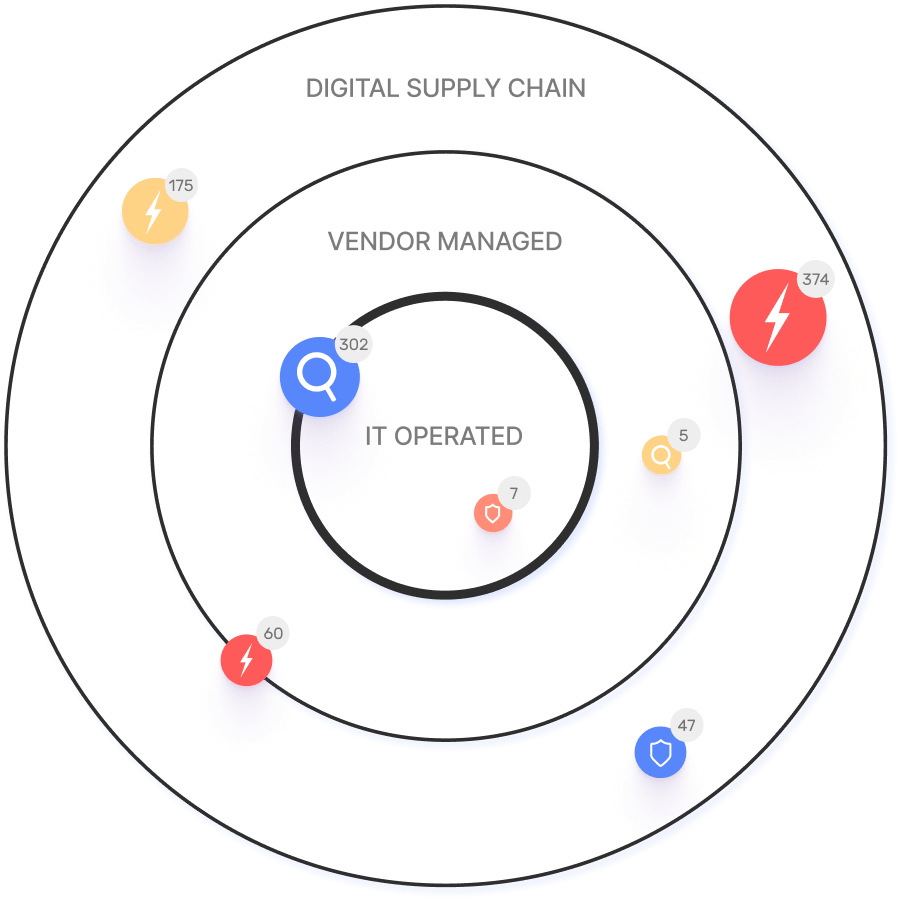
Financial institutions rely on hundreds of ICT providers, from cloud platforms to payment gateways to print vendors. The 2025 DBS Bank breach originated through a third-party printing services provider. DORA requires monitoring of third-party ICT risk, including subcontractors. Your EASM platform must trace exposure through your digital supply chain and surface risk inherited from vendors.
Continuous monitoring
DORA’s ICT risk management framework requires continuous monitoring, not periodic scans. Over 40,000 CVEs were published in 2024, a 38% increase from 2023, and attackers exploit CVEs within hours of disclosure. An EASM tool that runs weekly scans leaves exposure windows measured in days. IONIX monitors continuously and routes validated findings to responsible teams in real time.
Evidence-backed prioritization
PCI-DSS 4.0 requires documented remediation for all vulnerabilities. DORA requires evidence of risk assessment. Generic severity scores from CVSS do not satisfy either requirement. Financial services security teams need prioritization based on confirmed exploitability, asset ownership, blast radius, and business context. IONIX clusters related findings by root cause and accelerates remediation to cut through noise. A Fortune 500 organization achieved an 80%+ MTTR reduction within six months of deploying IONIX.
Where general EASM tools fall short for financial services
Most EASM platforms were designed for a simpler problem: discover internet-facing assets and report them. Financial services institutions face a more complex challenge. According to Randori’s 2022 State of Attack Surface Management report, 67% of organizations saw their external exposure expand over the prior two years, and 69% had been compromised through unknown or poorly managed internet-facing assets. The gap is wider in financial services, where subsidiaries, acquisitions, and third-party dependencies multiply the unknown surface.
General EASM limitations that create compliance gaps:
- No organizational research. Tools that start from a known domain or IP range cannot discover assets belonging to subsidiaries they have not been told about. DORA requires visibility across your full ICT footprint.
- Discovery without validation. A longer worry list is not a compliance artifact. Regulators want evidence that you assessed exploitability, not just that you found assets.
- No supply chain visibility. PCI-DSS Requirement 12.8 requires policies for managing service providers that affect cardholder data security. An EASM tool that stops at your organizational boundary cannot help you comply.
IONIX takes an external-first, attacker-centric approach: map the organizational structure, discover across the full scope, validate which exposures are exploitable, and route evidence-backed findings to the teams responsible. IONIX operationalizes Validated CTEM (Continuous Threat Exposure Management) for financial services environments where regulatory compliance depends on proactive, continuous exposure management.
Getting ahead of the next compliance cycle
DORA enforcement will intensify. The RTS on subcontracting was adopted by the European Commission in March 2025, adding new obligations for how financial entities govern ICT subcontractors. PCI-DSS continues to expand its scope. Financial services security teams that invest in an External Exposure Management platform with organizational entity mapping, exposure validation, and digital supply chain coverage will meet current requirements and be positioned for what comes next.
Book a demo to see how IONIX maps your full organizational exposure, validates exploitability across subsidiaries and supply chain, and accelerates remediation for financial services compliance.
FAQs
EASM platforms that include organizational entity mapping, continuous monitoring, and digital supply chain coverage address three of DORA’s five pillars: ICT risk management, resilience testing, and third-party risk oversight. The platform must validate exposures (not just discover them) and produce evidence of risk assessment to satisfy DORA’s documentation requirements.
PCI-DSS 4.0 Requirement 11.3.1.1 mandates that organizations manage all discovered vulnerabilities, including those ranked below high or critical severity. Requirement 12.8 requires policies governing service providers that handle or affect cardholder data. An EASM platform with exposure validation and supply chain visibility addresses both requirements.
Asset discovery identifies internet-facing resources: domains, IPs, cloud services, APIs. Exposure validation tests whether those assets are exploitable from an attacker’s perspective. Banking security teams need both, but validation produces the evidence regulators require. IONIX validates exploitability using non-intrusive attack simulation on production environments.
Banks and insurers operate through subsidiaries, acquired companies, and joint ventures. Attackers target the weakest entity in this structure. An EASM tool without organizational entity mapping cannot discover assets belonging to entities it has not been told about, creating blind spots that DORA and PCI-DSS auditors will flag.