
From CVE to Confirmed, Mitigated Exposure in 12 Hours: How Live Exposure Defense Sets a New EASM SLA


A CVE drops at 2 a.m. By the time your team finishes triage, attackers have already weaponized it. That gap, between disclosure and your answer, is where breaches start. Live Exposure Defense closes it with a hard commitment: from the moment a CVE is published, IONIX identifies every potentially affected asset across your external attack surface inside 12 hours. By end of June 2026, automated exploitability validation runs inside that same window. This is a committed SLA, reportable as a board-level metric. This article walks through what that commitment means and how the workflow delivers it.
The 12-hour SLA, and why most EASM vendors can’t make one
Most EASM and vulnerability management vendors treat a zero-day as a marketing moment. They publish a blog the day after disclosure. They send a “we are monitoring the situation” email. Then they leave your team to assemble the answer from scanners, spreadsheets, and CVE feeds. By the time triage finishes, the window has closed.
The numbers explain why the old model fails. Researchers published 40,009 new CVEs in 2024, a 38% jump over 2023, averaging 108 disclosures every day. Attackers move fast against that volume. In 2024, 768 CVEs were exploited in the wild, and 23.6% of newly tracked exploited vulnerabilities were hit on or before the day their CVE went public. AI-generated exploits compress the window further, a shift IONIX CEO Marc Gaffan documented in “Are You Ready for the CVE Avalanche?”.
A board metric needs a number you can commit to. Live Exposure Defense sets it at 12 hours from CVE publication to identification of every potentially affected asset across your external attack surface. The SLA is the product, not a content calendar.
Management is not enough. Mitigation is the point.
Gartner’s Preemptive Exposure Management (PEM) frame says security teams must get preemptive. IONIX delivers Preemptive Exposure Mitigation, because management without mitigation still leaves the exposure open. A dashboard that shows you a confirmed exploitable asset and stops there has handed you a longer worry list. Mitigation closes the asset.
This is the distinction that separates Live Exposure Defense from advisory content. EASM shows you what is exposed. IONIX shows you what is exploitable, then mitigates it. Live Exposure Defense is the operational proof point: a committed SLA, validated exploitability, and a deployable fix, acting across the CTEM lifecycle at machine speed.
How Live Exposure Defense works
The workflow runs as a continuous loop from CVE publication to resolved exposure. Six steps deliver the SLA.
1. The CVE Pipeline ingests every disclosure
The CVE Pipeline ingests every newly published CVE as it lands. Nothing waits for a weekly scan cycle or an analyst to notice a headline. The pipeline view inside the platform shows where each disclosed CVE sits in the loop: identified, validated, mitigation recommended, or resolved. Your team sees status, not a backlog.
2. Agentic analysis filters 100+ daily CVEs to the few that matter
More than 100 CVEs publish daily. Few of them touch your environment. IONIX Agentic Analyst filters the daily volume down to the small set that materially affects you, factoring in unauthenticated exploitability, public proof-of-concept availability, deployment footprint, and severity. Humans govern, agents operate. The agent does the triage at machine speed; your team sets the policy.
3. IONIX identifies every affected asset inside 12 hours
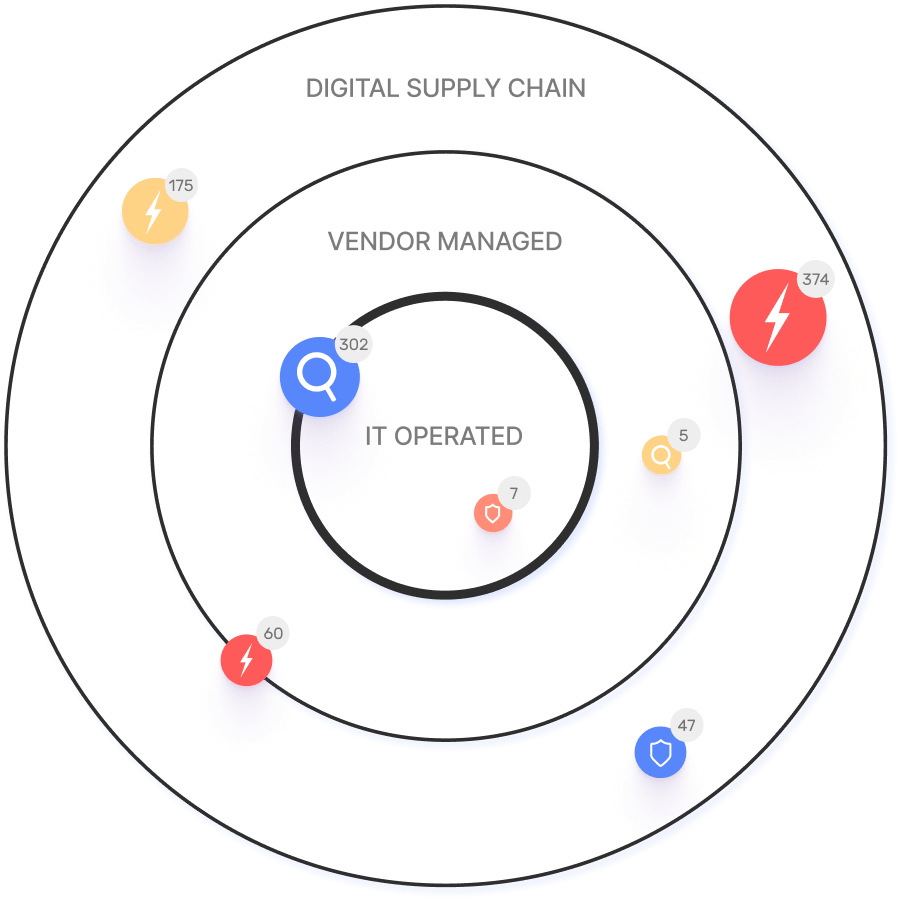
Within 12 hours of publication, IONIX identifies every potentially affected asset across your external attack surface. Coverage starts from a verified organizational entity map: subsidiaries, acquisitions, affiliated brands, and digital supply chain dependencies. Most tools find the assets you know about. IONIX starts by figuring out what you own, including the subsidiary you acquired three years ago and the brand the security team forgot. By end of June 2026, automated exploitability validation runs inside the same 12-hour window, confirming which of those assets an attacker can actually reach.
4. WAF rules ready to deploy for confirmed exploitable web assets
For confirmed exploitable web assets, IONIX recommends specific WAF rules ready to deploy through Akamai, Cloudflare, AWS, Azure, Imperva, Fortinet, and other supported vendors. Most vendors send you a list. IONIX sends you the validated, exploitable assets and the rule to mitigate them. Your team deploys a control while the patch is still in change management.
5. Active Protection defends dangling assets automatically
For dangling assets and DNS hijack targets, Active Protection defends automatically. These are the assets nobody owns and nobody patches, the orphaned subdomains and decommissioned records attackers take over without touching your production stack. Active Protection covers them without a ticket.
6. Every action feeds existing workflows
Every action feeds into the workflows your team already runs. Confirmed exposures and recommended mitigations flow into Jira or ServiceNow, tied to asset ownership and grouped by choke point. Your analysts work the queue they know, with evidence-backed findings instead of a raw CVE feed.
The board question has a one-page answer
“Are we exposed to the latest CVE?” arrives by phone, usually within hours of a headline. Without Live Exposure Defense, answering it means pulling an analyst off their work to cross-reference scanner output against a CVE feed and an asset inventory that may be weeks stale. The honest answer is often “we are still checking.”
Live Exposure Defense changes the answer to a single page: every affected asset identified, exploitability validated, mitigations recommended or already deployed, status visible in the CVE Pipeline. The answer is ready before the call comes. That is what a 12-hour SLA buys: not a faster scramble, a standing commitment.
Stop sending lists. Start mitigating.
The CVE volume is rising, AI is compressing the exploitation window, and your board wants an answer in hours. Discovery without validation produces a longer worry list. Management without mitigation leaves the exposure open. Live Exposure Defense answers with a 12-hour SLA, validated exploitability, deployable WAF rules, and automated protection across your full organizational scope. From CVE to confirmed, mitigated exposure in 12 hours, every time. Book a demo to see the CVE Pipeline run against your attack surface.
FAQs
IONIX commits to identifying every potentially affected asset across your external attack surface within 12 hours of a CVE being published. By end of June 2026, automated exploitability validation runs inside that same 12-hour window. The commitment is reportable as a board-level metric.
The IONIX Agentic Analyst filters the daily volume down to the small number of CVEs that materially affect your environment. It factors in unauthenticated exploitability, public proof-of-concept availability, deployment footprint, and severity, so your team reviews the few exposures that matter rather than triaging the full feed.
For confirmed exploitable web assets, IONIX recommends specific WAF rules ready to deploy through Akamai, Cloudflare, AWS, Azure, Imperva, Fortinet, and other supported vendors. For dangling assets and DNS hijack targets, Active Protection defends automatically. Every action feeds existing Jira or ServiceNow workflows. See WAF Posture Management for how rule recommendations work across vendors.
Standard EASM discovers internet-visible assets and reports what exists. Live Exposure Defense adds exposure validation and mitigation on a committed timeline, confirming which discovered assets are exploitable and handing your team the rule to close them.