

Security Control Validation for the External Perimeter: Why Internal BAS Tools Miss Your WAF


Your breach and attack simulation platform tests your endpoint detection, your SIEM correlation rules, and your network segmentation. It does not test your web application firewall the way an attacker hits it. The reason is architectural. An internal simulator sits behind or beside the firewall. The attacker sits on the internet. Those are two vantage points, and only one of them is where breaches start.
Security teams evaluating security control validation increasingly assume a breach and attack simulation (BAS) or adversarial exposure validation (AEV) platform already covers their web perimeter. It does not, and no amount of new features will change that. This article explains the two structural gaps that keep internal tools away from your WAF, and what external security control validation looks like when you run it from the attacker’s position.
What security control validation is, and what it proves
Security control validation (SCV) is the practice of testing whether a deployed control actually works, rather than assuming it works because it appears in an inventory. Instead of trusting that a firewall, an EDR agent, or a web application firewall (WAF) protects you because it is installed and licensed, SCV runs real attack techniques against the control and records whether it blocks, detects, or silently lets the attack through. The output is evidence, not assumption.
Gartner formalized the adjacent market as Adversarial Exposure Validation. Gartner defines AEV as technologies that deliver consistent, continuous, and automated evidence of the feasibility of an attack, confirming how attack techniques would circumvent prevention and detection controls. AEV replaced two earlier categories, breach and attack simulation and automated penetration testing, and serves the Validate stage of the Gartner Continuous Threat Exposure Management (CTEM) framework.
The practice exists because controls fail silently and constantly. Picus Security’s Blue Report 2026, built on more than 338 million attack simulations run in production environments, found that only 37% of post-compromise attacker actions were blocked, as reported by The Globe and Mail. Your controls report healthy while attackers walk through most of what they try. The gap between believed protection and actual protection is the entire reason SCV exists.
Why internal BAS and AEV tools were built for internal controls
BAS and AEV vendors like Picus Security, Cymulate, SafeBreach, AttackIQ, Pentera, and Validato are genuinely good at what they were built for. Their architecture places agents or simulators inside the network and tests the controls that live there: EDR, SIEM detection rules, network segmentation, and email gateways. Gartner notes that AEV is generally delivered as SaaS with or without on-premises agents. That inside-out design is correct for internal controls.
It is the wrong design for the WAF, and for two structural reasons.
Gap one: position
An internal simulator testing a WAF tests from behind or beside the control, not from the internet where the attacker sits. That matters because a WAF’s real behavior only reveals itself from outside. External reachability, edge routing, CDN behavior, TLS termination, and origin exposure are properties of the path an attacker takes to reach your application. A simulator on the internal network never travels that path. It reaches the origin directly, skipping the edge, and reports on a control it never approached the way an adversary would.
A WAF can block a textbook payload from the inside and still fail on a trivially encoded variant sent from the internet. The dashboard stays green either way. Only outside-in testing catches the difference.
Gap two: scope
The scope gap is the more important one. BAS and AEV tools validate controls on the assets you registered with them. You cannot validate a control on an asset you do not know exists. The web assets most likely to be unprotected are exactly the ones nobody registered anywhere: subsidiary-run properties, forgotten marketing microsites, and cloud-hosted apps a business unit stood up outside procurement.
An attacker does not target your primary domain first. They target the weakest asset in your organization, and that asset is often a property your security team never scoped into any tool. Coverage precedes validation. An internal platform that starts from a hand-maintained target list cannot supply the coverage, because the coverage problem is a discovery problem, and discovery has to start from the outside.
Why WAFs fail, and why the failure stays invisible
WAF failures are predictable and boring rather than exotic. A WAF misconfiguration analysis found that misconfigured WAFs fail to block up to 70% of common attack patterns. Three failure modes account for most of it.
- Mode changes. An engineer switches a rule set from blocking to monitoring during a deployment window and never switches it back. Attacks now generate log entries instead of blocks.
- Rule deletion. A troubleshooting session disables a rule causing false positives. The engineer fixes the application issue and forgets to re-enable the rule. Rule count drops from 234 to 189, and nobody notices.
- HTTPS inspection gaps. Deep inspection was never configured, was misconfigured, or was quietly disabled during maintenance, so encrypted traffic bypasses inspection entirely.
None of these register as an outage. The WAF keeps running. The dashboard reports healthy. The exposure stays open until an attacker finds it or someone tests from the outside.
What external-first security control validation looks like
IONIX WAF Posture Management applies security control validation to the most externally exposed control in the stack, from the real attacker position. Three arguments carry the approach.
Coverage precedes validation. IONIX starts with organizational entity mapping across subsidiaries, acquisitions, and affiliated brands, then discovers every internet-facing web asset in that scope. Each asset gets classified as Protected (active WAF with blocking rules), Underprotected (WAF present but in monitor-only mode), or Unprotected (no WAF at all), with the specific product identified across Akamai Kona, Cloudflare, AWS WAF, AWS CloudFront, Azure WAF, Imperva, Fortinet FortiWeb, Barracuda, Fastly, Palo Alto, and 50 or more others. Validation runs against the discovered estate, not a list someone maintains by hand.
Validation runs outside-in, without agents. IONIX tests from the internet against real production assets, using non-intrusive attack scenario testing that covers the OWASP Top 10: reflected, stored, and DOM-based XSS; UNION, blind, and time-based SQL injection; plus RCE, command injection, path traversal, and CSRF. It also tests bypass-aware evasion, including URL encoding, double encoding, case variation, comment insertion, parameter splitting, and HTTP request smuggling. A WAF that blocks the textbook payload but fails on an encoded variant is not delivering the protection its dashboard claims. Per-asset output reads like a verdict: active blocking confirmed, 234 active rules, last rule update 2026-03-15, 15 of 15 attack scenarios blocked, no bypass paths detected.
IONIX closes the loop with mitigation. Classic SCV tools tell you a control failed and hand the finding back. IONIX produces the specific WAF rule ready to deploy through your existing Akamai, Cloudflare, AWS WAF, Azure WAF, Imperva, Fortinet, Barracuda, Fastly, or Palo Alto deployment. Findings feed into your Jira or ServiceNow workflows with the action, the evidence, and the rule together. Management is not enough. Mitigation is the point.
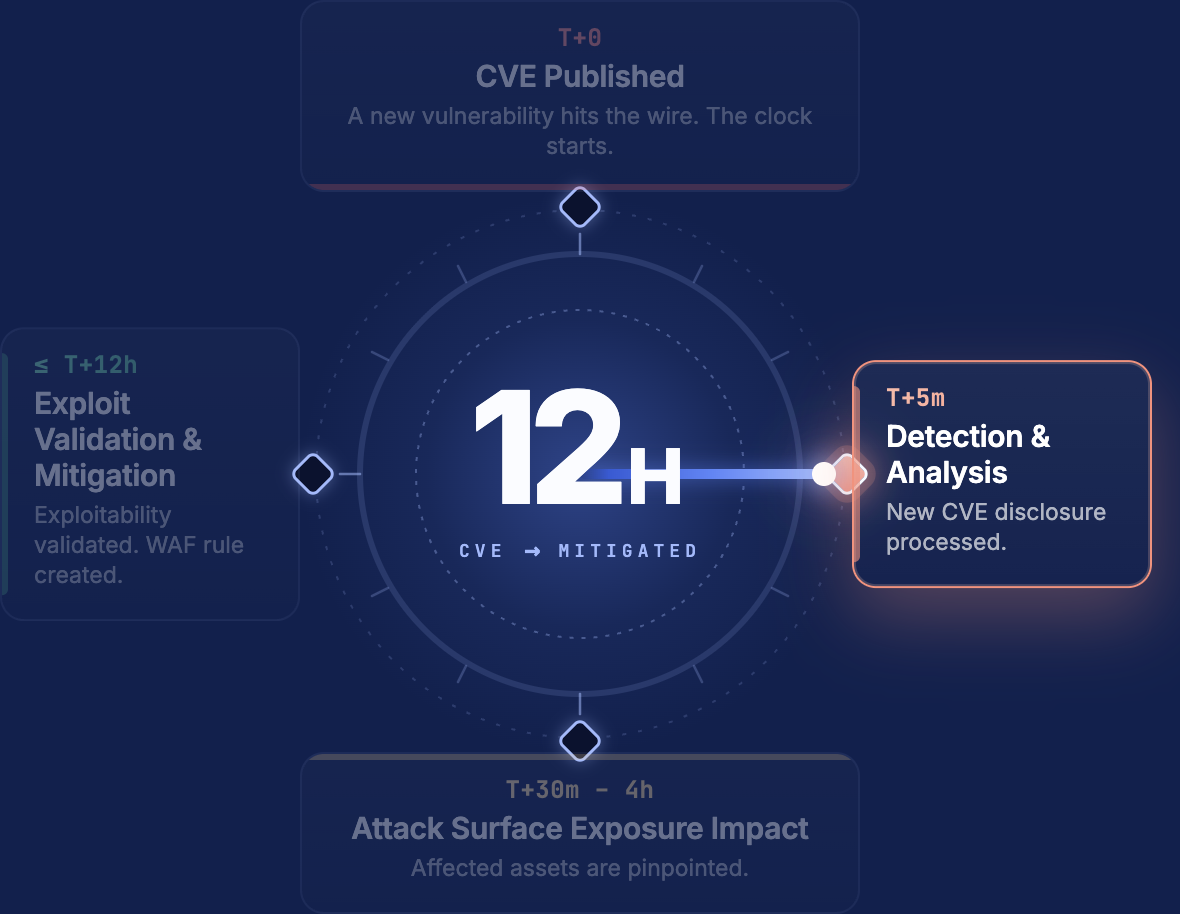
Two capabilities extend the model. Continuous configuration drift detection alerts when rule count changes, mode flips from blocking to monitoring, or sensitive rules get disabled, with context like “WAF rule count decreased from 234 to 189 on 2026-03-20. Review change log for approval.” Live Exposure Defense adds a 12-hour SLA from CVE publication to validated exposure, linking emerging CVEs to WAF rule deployment status so a missing rule for an actively exploited CVE escalates immediately.
Keep the BAS platform. Add external-first validation.
This is a complementarity verdict, not a takedown. Your BAS or AEV platform is the right tool for internal controls, and you should keep running it against EDR, SIEM detection rules, network segmentation, and email gateways. That is the work it was built for, and it does it well.
The WAF is a different problem. Validating it requires testing from the internet and, before that, discovering every web asset an attacker can reach, including the ones no internal tool was ever told about. Coverage precedes validation, and no inside-out platform can supply the coverage. Add external-first validation for the perimeter, and let each tool do the job its architecture was designed for.
Your WAF dashboard says you are protected. An attacker on the internet is the only party positioned to prove otherwise, and so is a validation platform that tests from the same place. See how IONIX validates your WAF from the outside in.
FAQs
They need a single source of truth that sits outside any one vendor’s console. Native consoles from Akamai, Cloudflare, AWS, and Azure each report only on their own estate, so a security team running five WAF vendors has five partial views and no unified answer. IONIX discovers every internet-facing web asset across subsidiaries and classifies each as Protected, Underprotected, or Unprotected, identifying the specific WAF product across 50 or more supported vendors. See WAF coverage across multi-cloud vendors for the full approach.
Native consoles are strong for configuring the vendor you are logged into and blind to everything else. A third-party WAF posture management tool gives you one view across every vendor, validates that each WAF actually blocks live attacks from the outside, and flags configuration drift the native console treats as normal. For a single-vendor shop, the native console may be enough. For a multi-vendor, multi-subsidiary enterprise, it is not.
Yes. IONIX WAF Posture Management maps your full organizational entity model first, covering subsidiaries and acquisitions, then discovers every internet-facing web asset in that scope and reports the WAF status of each, whether it sits behind Akamai, AWS WAF, or any of 50 or more supported products. The result is one dashboard that answers which subsidiary assets are protected, which are in monitor-only mode, and which have no WAF at all.
No. BAS and AEV platforms validate internal controls such as EDR, SIEM detection rules, and network segmentation, and they should keep doing that. External-first validation covers the perimeter those tools cannot reach: the WAF, tested from the internet, across web assets an internal target list never included. The two are complementary.