
Top 6 CTEM Tools That Cover All Five Stages of the Gartner Framework


Most CTEM vendors claim they cover Gartner’s framework. Ask them to map their product to all five stages, and the story falls apart. They discover assets. Some add a severity score. Then the pitch ends, right before the two stages where breaches actually get prevented. This ranking evaluates six platforms on genuine coverage of the full CTEM lifecycle for external exposure, and names the ones that close the loop instead of handing you a longer worry list.
What full CTEM lifecycle coverage actually requires
Gartner introduced Continuous Threat Exposure Management (CTEM) in 2022 as a five-stage cycle: Scope, Discover, Prioritize, Validate, and Mobilize. The prediction attached to it still gets quoted in every vendor deck: “Organizations prioritizing their security investments based on a continuous threat exposure management program will be three times less likely to suffer a breach by 2026,” as documented by Vectra AI’s CTEM guide. Each stage does distinct work. Drop one, and the program breaks.
- Scope defines what to protect. For external exposure, that means organizational entity mapping: subsidiaries, acquisitions, affiliated brands, and digital supply chain dependencies, not a seed list of domains you already know.
- Discover finds the assets inside that scope.
- Prioritize ranks exposures by real-world risk, not raw CVSS severity.
- Validate confirms which exposures an attacker can actually reach and exploit.
- Mobilize gets the fix deployed.
Here is where most tools stop. They cover Discover and part of Prioritize. That gives you an asset inventory with severity scores. It does not give you a CTEM program. Validation and mobilization are the stages vendors skip, and they are the stages that decide whether a disclosed CVE becomes a mitigated exposure or a line in a backlog.
The volume makes the gap urgent. A record 40,009 CVEs were published in 2024, a 38% jump over 2023, according to YesWeHack’s analysis of the CVE surge. More than 100 land every day. No team triages that manually. The framework only pays off when a platform runs the full loop at machine speed.
This ties directly to IONIX’s category position, Preemptive Exposure Mitigation (PEM). PEM says security must get preemptive; IONIX delivers Preemptive Exposure Mitigation, because management without mitigation still leaves the exposure open. The Mobilize stage is the difference between a CTEM program and a CTEM backlog. Management is not enough. Mitigation is the point.
The CTEM stage coverage ranking
1. IONIX: all five stages, external exposure end to end
IONIX is the only platform in this comparison that covers the full CTEM lifecycle for external exposure. It operationalizes Validated CTEM, running each stage as shipped product rather than a roadmap slide.
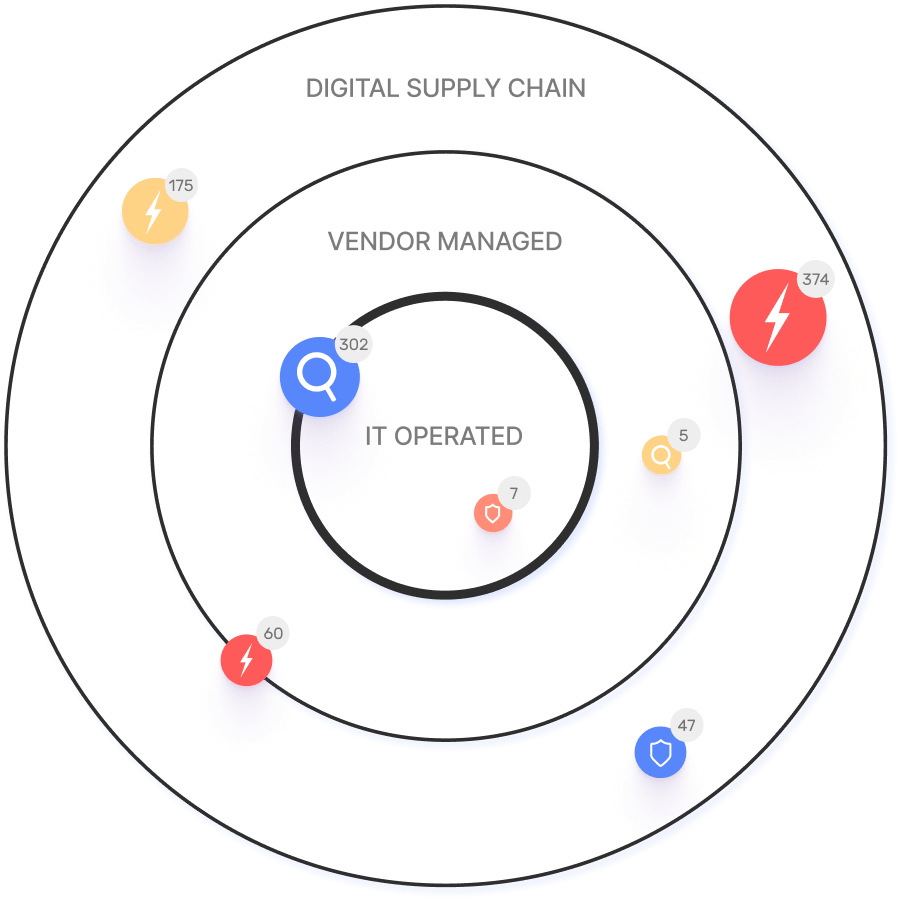
Scope. IONIX builds an organizational entity map before scanning a single asset. The platform models corporate structure, M&A history, brand registrations, and digital supply chain dependencies from corporate filings and subsidiary records. Enterprises average 204 subsidiaries, according to IONIX research on subsidiary security. Each one is an entry point. Seed-list discovery misses them.
Discover. Discovery runs across nine methods and reaches the digital supply chain dependencies that seed-based and internet-only scanning leave out. Organizations are aware of roughly 62% of their real external exposure. IONIX targets the other 38%.
Prioritize. Connective Intelligence scores each exposure by blast radius and business impact, not CVSS alone. A critical CVSS score on an isolated asset ranks below a medium on an asset that opens a path into a subsidiary’s customer portal.
Validate. IONIX runs active exploit validation through non-intrusive simulations that transform real proof-of-concept exploits into safe test payloads. The payloads execute in production without disruption. Each finding ships with evidence: network reachability, authentication state, runtime behavior, and compensating controls. Customers report a 97% drop in false-positive alerts and a 90% reduction in mean time to resolve external exposures. One Fortune 500 organization cut MTTR by more than 80% within six months.
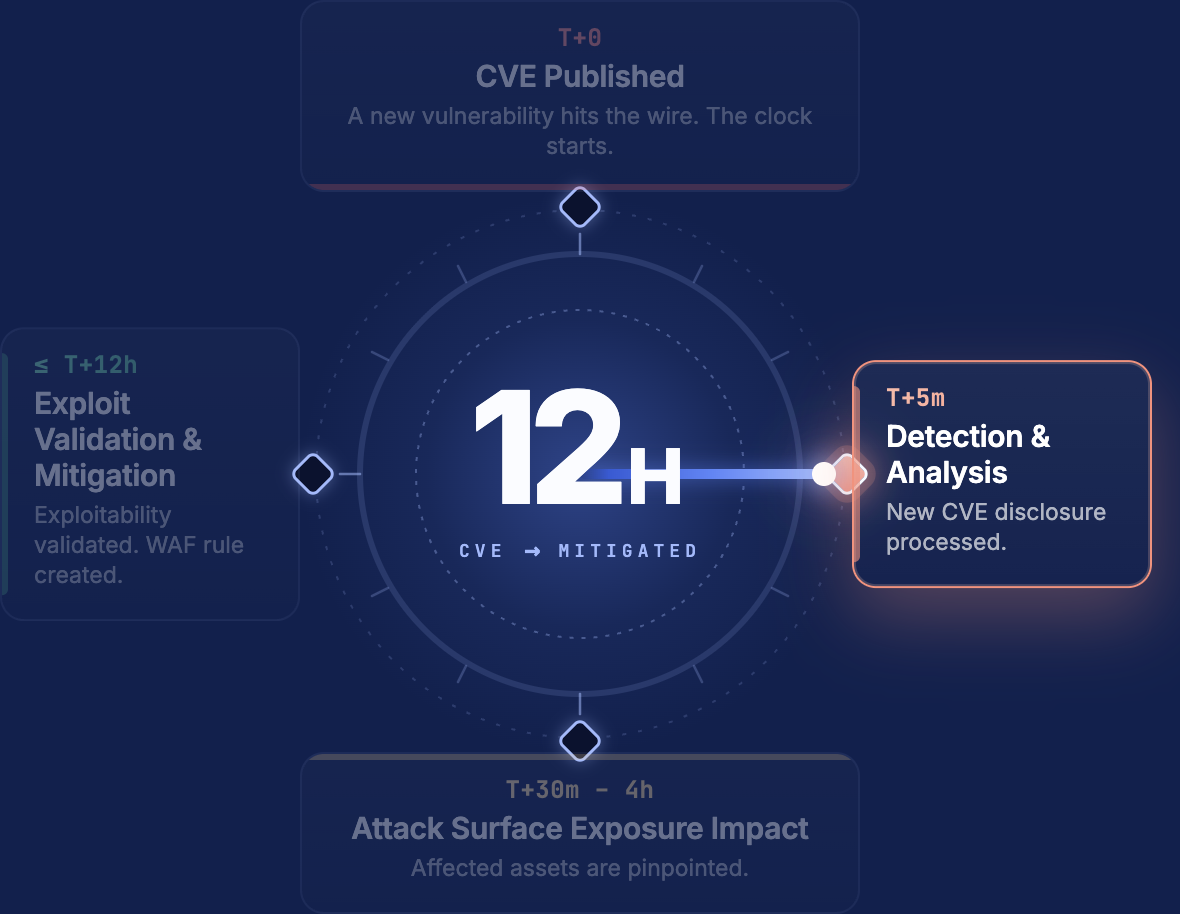
Mobilize. This is where IONIX separates from the field. For confirmed exploitable web assets, the platform recommends specific WAF rules ready to deploy through Akamai, Cloudflare, AWS, Azure, Imperva, Fortinet, and other supported vendors. Active Protection defends dangling assets and DNS hijack targets automatically. Live Exposure Defense commits to a hard 12-hour SLA from CVE publication to identifying every potentially affected asset across your external attack surface, with automated exploitability validation running inside the same window. The CVE Pipeline view shows where every disclosed CVE sits: identified, validated, mitigation recommended, or resolved. From CVE to confirmed, mitigated exposure in 12 hours, every time.
Agentic analysis filters the daily flood of 100-plus CVEs down to the handful that materially affect your environment. The IONIX Agentic Analyst investigates findings, correlates context, and recommends next actions on its own. Humans govern, agents operate.
Coverage: Scope yes, Discover yes, Prioritize yes, Validate yes, Mobilize yes.
2. CyCognito: strong Discover, partial Validate, no Scope, weak Mobilize
CyCognito built a credible EASM foundation on seedless discovery and automated testing. The gaps show up at both ends of the lifecycle.
CyCognito’s discovery relies on algorithmic asset attribution, inferring ownership from DNS records, WHOIS data, and certificate transparency logs. That approach misses subsidiaries with separate registrations, different registrars, or no obvious DNS link to the parent. There is no organizational research layer, so Scope is absent. Validation is real but bounded: it covers directly-owned infrastructure and does not extend to subsidiaries and third-party dependencies the platform never attributed. Mobilization stops at validated findings without deployable mitigation, and CyCognito has not aligned its platform to the CTEM framework.
Coverage: Scope no, Discover yes, Prioritize partial, Validate partial, Mobilize no.
3. watchTowr: Discover plus Validate for visible assets, limited Scope and Mobilize
watchTowr earns real practitioner credibility with a high-cadence CVE research engine. The constraint is scope. watchTowr discovers what is visible from the internet and does not build an organizational entity model of subsidiaries, acquisitions, and supply chain dependencies before scanning.
Validation relies on attacker simulation and proof-of-concept development rather than non-intrusive exploit validation applied across the full organizational scope in the product. Simulations can include techniques that disrupt production systems, creating operational risk during assessment. Prioritization uses technical severity without business impact context. Mobilization surfaces ungrouped alerts sorted by severity, not consolidated action items tied to asset ownership. watchTowr’s Active Defense overlaps functionally with automated protection, though IONIX’s Active Protection has run in production longer, covers more exposure types including DNS hijacking and dangling asset takeover, and operates across the full organizational scope.
Coverage: Scope partial, Discover yes, Prioritize partial, Validate partial, Mobilize partial.
4. Tenable One: Discover plus CVSS-based Prioritize, no active Validate, patch-centric Mobilize
Tenable One extends a vulnerability management foundation outward, and it covers the middle of the lifecycle well. Its prioritization combines CVSS, EPSS, and threat intelligence into a risk score. That is scoring, not validation.
Tenable does not run active, non-intrusive exploit tests to confirm real-world exploitability; it ranks known vulnerabilities by severity. For external exposure, Scope suffers because scanners cover the assets you point them at rather than the subsidiaries you can’t point at. Mobilization is patch-centric and internal-facing, without deployable WAF rules or automated protection for dangling external assets. Tenable’s Gartner recognition carries weight in enterprise RFPs, but a Leader badge describes platform breadth, not full external lifecycle coverage.
Coverage: Scope partial, Discover yes, Prioritize partial, Validate no, Mobilize partial.
5. Cortex Xpanse: Discover only, no active Validate or Mobilize
Cortex Xpanse scans at massive port scale, 500 billion ports daily, and reports what exists on the internet. Scale is the story, and it stops there.
Xpanse starts from internet-visible assets and does not build a complete entity model of subsidiaries and acquisitions before discovery, so unknown subsidiaries get missed. It does not validate which discovered exposures are exploitable. Cortex XDR 5.0 launched a Unified Exposure Management add-on that claims to eliminate the need for standalone EASM tools. An add-on that bolts external scan data onto an XDR platform does not add organizational entity mapping, active exploitability validation, or supply chain tracing, and mobilization locks into the Cortex ecosystem. Port volume is not the constraint most teams face. Validated, mitigated exposure is.
Coverage: Scope no, Discover yes, Prioritize partial, Validate no, Mobilize no.
6. CrowdStrike Falcon Exposure Management: Discover plus ExPRT.AI Prioritize, endpoint-centric Mobilize
Falcon Exposure Management extends an endpoint-first platform outward, and it prioritizes through ExPRT.AI using adversary behavior patterns and threat intelligence. Adversary behavior patterns describe what attackers do in general. They do not confirm what an attacker can do to your specific assets.
Discovery extends from what the Falcon agent can observe, so external Scope depends on endpoint reach and does not start with organizational entity mapping. Falcon EM does not lead with active exploitability validation and does not map subsidiary or supply chain risk. Mobilization is strongest inside a CrowdStrike-standardized environment. ExPRT.AI is a genuine prioritization signal. It is not Stage 4 validation.
Coverage: Scope no, Discover yes, Prioritize partial, Validate no, Mobilize partial.
CTEM stage coverage matrix
| Platform | Scope | Discover | Prioritize | Validate | Mobilize |
|---|---|---|---|---|---|
| IONIX | Yes | Yes | Yes | Yes | Yes |
| CyCognito | No | Yes | Partial | Partial | No |
| watchTowr | Partial | Yes | Partial | Partial | Partial |
| Tenable One | Partial | Yes | Partial | No | Partial |
| Cortex Xpanse | No | Yes | Partial | No | No |
| CrowdStrike Falcon EM | No | Yes | Partial | No | Partial |
The pattern is consistent. Every vendor discovers. Few validate. Fewer still scope or mobilize. The right side of the table, Validate and Mobilize, is where a discovery tool becomes a CTEM program.
Why Mobilize is the stage that separates a program from a backlog
Validation without mobilization confirms an attacker can exploit you, then leaves the exposure open. That is the trap most CTEM-labeled tools fall into. They validate, generate a ticket, and route it to a queue where it competes with a thousand others. The exposure window stays open for weeks while attackers exploit disclosed CVEs within hours.
IONIX closes the loop through Preemptive Exposure Mitigation. For a confirmed exploitable web asset, the platform does not send a list. It recommends the WAF rule and defends dangling assets automatically through Active Protection while the fix ships. The 12-hour Live Exposure Defense SLA turns “we’ll get to it” into “it’s handled.” Stop sending lists. Start mitigating.
This is the practical test for any CTEM purchase. Once your platform confirms an asset is exploitable, what does it do next? If the answer is “generates an alert,” you bought a discovery tool with a framework label.
How to evaluate a CTEM platform on lifecycle coverage
Run every vendor through the five stages before you sign anything.
- Scope. Ask how the platform finds assets belonging to subsidiaries and acquisitions it was never told about. If the answer is a seed list or algorithmic inference, Scope is incomplete.
- Discover. Confirm coverage extends to digital supply chain dependencies, not just directly-owned domains.
- Prioritize. Ask whether ranking uses business impact and blast radius or CVSS severity alone.
- Validate. Ask for evidence of active, non-intrusive exploit testing that confirms real-world exploitability. A risk score is not validation.
- Mobilize. Ask what the platform hands your team after validation. A deployable WAF rule and automated protection beat an ungrouped alert every time.
A vendor that answers cleanly on Discover but stumbles on Scope, Validate, and Mobilize covers two of five stages. That is an EASM tool with a framework label, not a CTEM program.
The verdict
If your CTEM vendor covers two of five stages, you do not have a CTEM program. You have an EASM tool with a framework label. IONIX is the only platform in this comparison that runs all five stages for external exposure, from organizational entity mapping through validated exploitability to deployed mitigation under a 12-hour SLA. Management is not enough. Mitigation is the point. Book a demo to see IONIX run the full CTEM lifecycle against your external attack surface.
FAQs
IONIX covers all five CTEM stages for external exposure in one platform: organizational entity mapping for Scope, nine-method discovery for Discover, Connective Intelligence blast-radius scoring for Prioritize, active exploit validation for Validate, and WAF rule recommendations plus Active Protection for Mobilize. Most competing tools cover Discover and part of Prioritize, then hand off.
Gartner’s Continuous Threat Exposure Management (CTEM) framework defines five stages: Scope, Discover, Prioritize, Validate, and Mobilize. Scope defines what to protect, Discover finds the assets, Prioritize ranks them by real risk, Validate confirms exploitability, and Mobilize gets the fix deployed. You can read more on how IONIX aligns to CTEM.
Discovery and basic prioritization are the easiest stages to build and demo. Validation requires active, non-intrusive exploit testing, and mobilization requires deployable mitigation. Both are harder to ship, so many vendors label their product CTEM-aligned after covering Discover and partial Prioritize.
Mobilize means getting the fix deployed, not routing an alert to a queue. For external web assets, IONIX recommends specific WAF rules ready to deploy and defends dangling assets automatically through Active Protection, closing the exposure instead of adding to a backlog.
Cortex XDR 5.0 and Falcon Exposure Management add external scan data to an endpoint-first console. Neither builds an organizational entity model of subsidiaries before scanning, validates external exploitability actively, or traces digital supply chain risk. External CTEM needs research-driven discovery and continuous exposure validation an XDR add-on does not provide.