

Top 7 CyCognito Alternatives for Preemptive Exposure Mitigation in 2026


Teams evaluating CyCognito alternatives in 2026 share one reason for looking: CyCognito reports what it finds, and that is no longer enough. CyCognito earns its reputation. Its seedless discovery surfaces internet-visible assets without a seed list, and it runs some automated security testing on directly-owned infrastructure. For teams that want a broad external inventory, CyCognito delivers. The problem starts after the finding. CyCognito does not produce deployable WAF rule guidance for confirmed exploitable web assets. It does not commit to a published SLA on CVE-to-mitigation response. It does not autonomously defend dangling assets. And it does not extend validation to subsidiaries or supply chain dependencies. Teams that need mitigation, not a longer worry list, hit those limits fast.
That gap defines the shift the market is making. Discovery without validation produces a longer list. Management without mitigation leaves the exposure open. Gartner frames the answer as Preemptive Exposure Management. We sharpen it: PEM says security must get preemptive; IONIX delivers Preemptive Exposure Mitigation, because management without mitigation still leaves the exposure open. This guide ranks the top 7 CyCognito alternatives in 2026 against that standard. The buyer test runs through every entry: after a finding is validated, what does the platform hand your team?
Why CyCognito users look for alternatives
The numbers explain the pressure. Security teams handle a flood of findings, and only 0.47% of scanner findings are actually exploitable, according to Hadrian’s 2026 benchmark as reported by SecurityBrief UK. Meanwhile, Mondoo’s 2026 State of Vulnerabilities report counts 132 new CVEs published every day. A discovery-first tool turns that volume into triage work. Your analysts chase theoretical risk while the exploitable exposure sits open.
CyCognito reports what it finds. The board now asks a different question: are we exposed to the latest CVE, and what did we do about it, in hours rather than weeks? Answering that requires validation across the full organizational scope, deployable mitigation, and an SLA that holds. The seven platforms below are ranked on how completely they close that loop.
How we ranked the alternatives
Each platform scored on five capabilities that separate a Preemptive Exposure Mitigation platform from a CyCognito-class tool:
- Validation depth. Does it confirm real-world exploitability with active testing, or report what exists?
- Supply chain and subsidiary coverage. Does it map the full organizational entity model, or scan internet-visible assets only?
- Mitigation actions. After a finding is validated, does it hand the team a deployable action?
- CVE response SLA. Does it commit to a published window from CVE publication to identified exposure?
- Agentic operation. Does autonomous analysis filter the daily CVE volume and investigate findings?
1. IONIX — Preemptive Exposure Mitigation, delivered
IONIX ranks first because it answers the buyer test directly. Most vendors send you a list. IONIX sends you the validated, exploitable assets and the rule to mitigate them.
Before scanning a single asset, IONIX maps the full organizational picture: subsidiaries, acquisitions, affiliated brands, and digital supply chain dependencies. Discovery starts from a complete entity model, not a seed list and not algorithmic inference. Attackers target your weakest subsidiary, not your primary domain, and IONIX scopes that subsidiary before discovery begins.
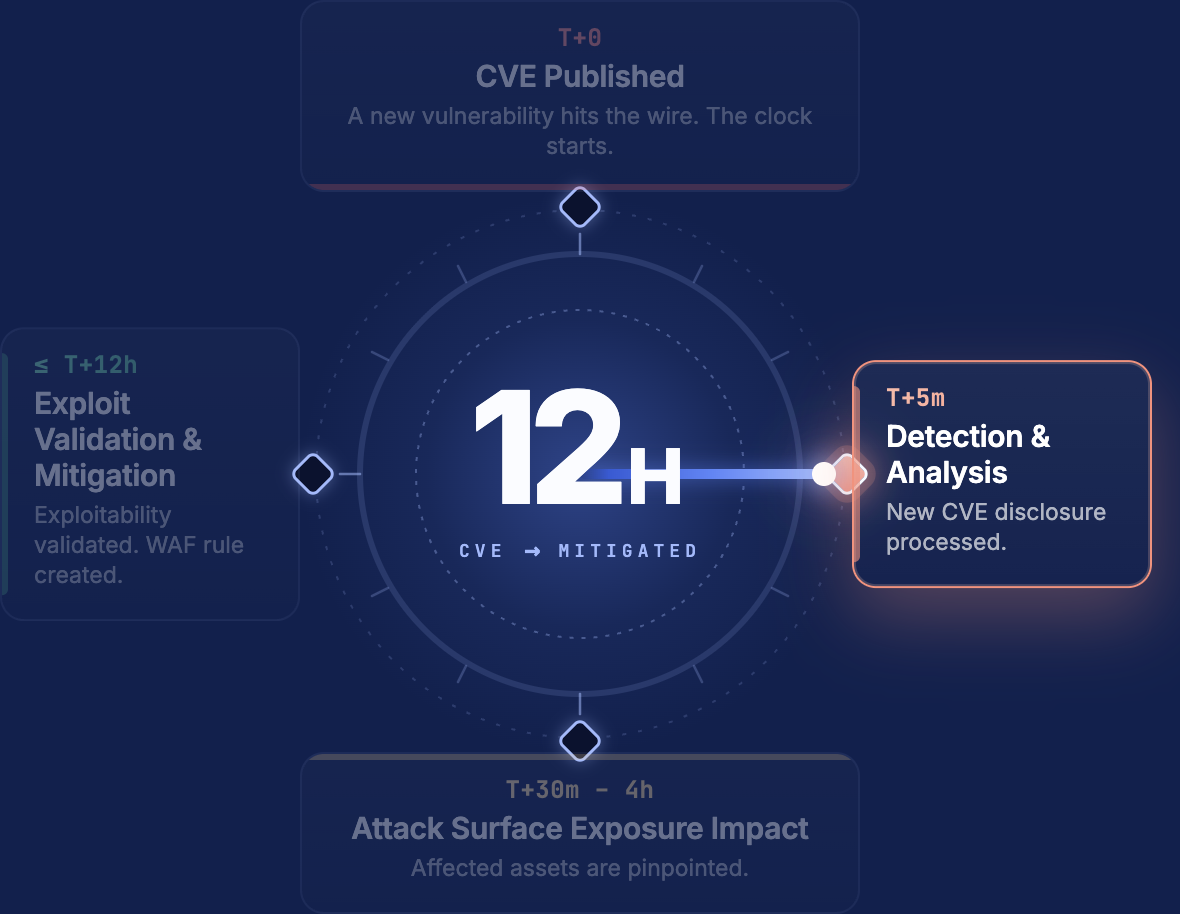
Validation runs across that full scope using active, non-intrusive exploitability testing. IONIX confirms which exposures are reachable and exploitable in your specific environment, then traces risk through subsidiaries and supply chain dependencies. The operational proof is Live Exposure Defense: a hard 12-hour SLA from CVE publication to identification of every potentially affected asset across your external attack surface. From CVE to confirmed, mitigated exposure in 12 hours, every time.
Mitigation is where IONIX separates from the field. For confirmed exploitable web assets, IONIX recommends specific WAF rules ready to deploy through Akamai, Cloudflare, AWS, Azure, Imperva, Fortinet, Barracuda, Fastly, Palo Alto, and 50+ other vendors through WAF Posture Management. Active Protection defends dangling assets and DNS hijack targets automatically. The CVE Pipeline view shows where every disclosed CVE sits in the loop: identified, validated, mitigation recommended, or resolved. The IONIX Agentic Analyst investigates findings, correlates context, and recommends further actions on its own. Humans govern, agents operate.
The outcomes follow the architecture. IONIX customers report a 90% reduction in mean time to resolve external exposures and a 97% drop in false-positive alerts. One Fortune 500 organization cut MTTR by more than 80% within six months. Exposure windows that stretched across weeks now close in hours. IONIX operationalizes the full CTEM lifecycle and carries no ecosystem dependency, working with any security stack.
Strengths: Organizational entity mapping, validated exploitability across subsidiaries and supply chain, 12-hour CVE SLA, deployable WAF rules across 50+ vendors, Active Protection, autonomous Agentic Analyst.
Limitation vs. CyCognito: IONIX does not lead with peer benchmarking or security ratings for board reporting. Teams that buy a tool mainly to produce a comparative score will weigh that.
Best for: Enterprise Attack Surface Owners and Vulnerability and Exposure Management Leaders with complex, multi-entity footprints who need validated, mitigated exposure, not another inventory.
2. Cortex Xpanse — enterprise port scanning at scale
Cortex Xpanse scans at massive port volume, 500 billion ports daily, and fits enterprises already standardized on the Cortex ecosystem. Cortex XDR 5.0 added a Unified Exposure Management add-on that claims to eliminate standalone EASM tools.
Strengths vs. CyCognito: Larger scan breadth and tight integration for Cortex shops with no new vendor required.
Limitations vs. IONIX: Xpanse starts from internet-visible assets and does not build a structured organizational entity model first, so assets belonging to unknown subsidiaries or recent acquisitions get missed. It does not lead with active validation of exploitability, and supply chain and subsidiary risk are not primary capabilities. An XDR add-on that bolts on external scan data does not validate which discovered exposures are exploitable or commit to a published CVE SLA. Most value concentrates inside Cortex.
Best for: Cortex-committed enterprises that prioritize coverage breadth over validated mitigation.
3. Tenable One — VM-extended EASM with broad vulnerability context
Tenable extends a vulnerability management foundation outward into exposure management and carries real weight in enterprise RFPs through its Gartner Exposure Assessment Platform Leader recognition and 300+ integrations.
Strengths vs. CyCognito: Deep vulnerability context and a broad integration ecosystem for teams that want exposure data inside a familiar VM platform.
Limitations vs. IONIX: Tenable’s scanners cover the assets you point them at. IONIX finds the ones you cannot point at. Tenable frames its AI as smarter prioritization rather than active exploitability validation, and its loop ends at prioritized findings. The platform does not commit to a 12-hour CVE-to-identified-exposure SLA, does not generate deployable WAF rules, and does not lead with subsidiary or supply chain scope. For a fuller comparison of moving past scanner heritage, see how EASM evolves into PEM.
Best for: Organizations standardized on Tenable’s vulnerability management who want external context inside that platform.
4. watchTowr — red-team adversary simulation and preemptive branding
watchTowr brings strong practitioner and red-team credibility and a high-cadence CVE research engine. It coined Preemptive Exposure Management and pushes it through weekly research.
Strengths vs. CyCognito: Research velocity and adversary-simulation depth that resonate with red teams.
Limitations vs. IONIX: The difference is the noun. Management normalizes dashboards and triage queues. Mitigation closes the exposure. watchTowr scans what is visible from the internet and relies on attacker simulation rather than non-intrusive exploit validation in the product, so it surfaces what could be exploitable rather than confirming what is. Its simulations include techniques that may disrupt production. It prioritizes on technical severity alone and surfaces ungrouped alerts. watchTowr hands you research. IONIX hands you the validated asset and the WAF rule to mitigate it. Management is not enough. Mitigation is the point.
Best for: Red teams and research-driven security functions that value CVE intelligence cadence.
5. Hadrian — agentic adversary simulation with European focus
Hadrian delivers agentic, AI-driven offensive security testing and continuous adversarial emulation, with a strong European presence. Its 2026 benchmark sharpened the industry case that most findings are not exploitable.
Strengths vs. CyCognito: Agentic pentesting and exploit validation that move past discovery-first triage.
Limitations vs. IONIX: Hadrian centers on offensive testing and pentest-style engagements rather than building a complete organizational entity model across subsidiaries, acquisitions, and supply chain before discovery. It does not commit to a published 12-hour CVE-to-identified-exposure SLA, and it does not generate deployable WAF rules or run Active Protection for dangling assets. Validation is the start. Mitigation inside an SLA is the outcome.
Best for: Teams that want continuous agentic pentesting, particularly in European markets.
6. CrowdStrike Falcon Exposure Management — endpoint-extended with threat intel
Falcon Exposure Management extends CrowdStrike’s endpoint platform outward, powered by ExPRT.AI adversary intelligence. For organizations standardized on Falcon, it adds with minimal procurement friction.
Strengths vs. CyCognito: Adversary-intelligence prioritization through ExPRT.AI and a natural fit for Falcon-standardized environments.
Limitations vs. IONIX: Falcon’s discovery extends from assets the agent can observe. ExPRT.AI prioritizes based on adversary behavior in other environments. IONIX validates based on what is reachable and exploitable in yours. Falcon Exposure Management does not map subsidiary risk or third-party supply chain dependencies, does not build an organizational entity model before scanning, and does not commit to a 12-hour CVE SLA or deliver deployable WAF rules. Its strongest value lands inside a CrowdStrike-standardized stack.
Best for: CrowdStrike-standardized teams that want exposure context around known endpoints.
7. Microsoft Defender EASM — bundled with E5, Azure-native
Defender EASM continuously discovers internet-visible assets and integrates with Defender and Sentinel, included in some E5 and Defender licensing tiers. The price objection is real for Microsoft-committed accounts.
Strengths vs. CyCognito: Zero marginal cost for E5 shops and frictionless Azure-native integration.
Limitations vs. IONIX: Defender EASM’s hero message is discovery. It starts from internet-visible assets and customer-provided seeds, so assets belonging to unknown subsidiaries stay hidden. It does not validate which discovered assets are exploitable, does not lead with subsidiary or supply chain mapping, and does not commit to a CVE SLA or generate deployable WAF rules. Its value concentrates in Azure-committed environments. For mixed-stack footprints, the gap widens.
Best for: Microsoft-committed organizations that want baseline discovery at near-zero marginal cost.
Capability matrix: top 7 CyCognito alternatives in 2026
| Platform | Validation depth | Supply chain and subsidiary coverage | Mitigation actions | CVE response SLA | Agentic operation |
|---|---|---|---|---|---|
| IONIX | Active, validated exploitability across full scope | Full organizational entity map | Deployable WAF rules, Active Protection | 12-hour published SLA | IONIX Agentic Analyst |
| Cortex Xpanse | Reports what exists; limited validation | Not a primary capability | Remediation guidance, no WAF rules | None published | Cortex platform AI |
| Tenable One | Prioritization, not active validation | Not a lead capability | Prioritized findings | None published | AI prioritization |
| watchTowr | Attacker simulation, not exploit validation | Internet-visible only | Research output | None published | Research engine |
| Hadrian | Agentic exploit validation | Limited entity scope | Remediation guidance | None published | Agentic pentesting |
| CrowdStrike Falcon EM | Threat-intel prioritization | Not covered | Prioritized findings | None published | ExPRT.AI |
| Defender EASM | Discovery, not validation | Not a lead capability | Discovery output | None published | Defender AI |
The buyer test for any CyCognito alternative
Run one test against every platform on this list. After a finding is validated, ask what the platform hands your team. If the answer is a threat advisory, a dashboard, a severity score, or a longer list, you are evaluating a CyCognito-class tool. If the answer is a deployable action inside a published SLA, you are evaluating a Preemptive Exposure Mitigation platform.
IONIX is built to pass that test. Validated exploitability across subsidiaries and supply chain. A 12-hour CVE SLA. WAF rules ready to deploy across 50+ vendors. Active Protection for dangling assets. An Agentic Analyst that investigates while your team governs. Stop sending lists. Start mitigating. See how IONIX validates and mitigates external exposure CyCognito leaves open, or book a demo.
Conclusion
CyCognito discovers and validates on directly-owned infrastructure, and that earns it a place in the market. The teams switching in 2026 need more: validation across the full organizational scope, mitigation that ships, and an SLA that answers the board in hours. Of the seven alternatives ranked here, IONIX is the only one that maps the entity model first, validates exploitability across subsidiaries and supply chain, and closes the loop with deployable WAF rules and automated protection. Management is not enough. Mitigation is the point.
FAQs
IONIX ranks as the strongest CyCognito alternative for teams that need mitigation, not just discovery. It maps your full organizational entity model first, validates exploitability across subsidiaries and supply chain, commits to a 12-hour CVE SLA through Live Exposure Defense, and recommends deployable WAF rules. CyCognito reports what it finds; IONIX confirms what is exploitable and hands your team the fix.
Both platforms discover and validate. CyCognito runs automated security testing on directly-owned infrastructure. IONIX validates exploitability across the full organizational scope, including subsidiaries, acquisitions, and digital supply chain dependencies, using active non-intrusive testing. The difference shows after validation: IONIX recommends a deployable WAF rule, while CyCognito stops at the finding.
Look for active exploitability validation in your specific environment, not severity scoring or attacker simulation. Confirm the platform extends validation to subsidiaries and supply chain dependencies, since attackers target the weakest connected entity. Then apply the buyer test: after a finding is validated, the platform should hand you a deployable action inside a published SLA, as IONIX does with WAF rule recommendations and a 12-hour CVE response window.
IONIX leads on this through organizational entity mapping and Exposure by Association, covering subsidiaries, acquisitions, and third-party dependencies before discovery begins. Most alternatives on this list, including Cortex Xpanse, Tenable One, Falcon Exposure Management, and Defender EASM, scan internet-visible assets and do not lead with subsidiary or supply chain coverage.
Exposure management surfaces and prioritizes what is exposed. Preemptive Exposure Mitigation closes the exposure. PEM says security must get preemptive; IONIX delivers it by validating exploitability across the full attack surface, then shipping a deployable mitigation inside a 12-hour SLA. Management normalizes dashboards and triage queues. Mitigation removes the open exposure.