
NEW! WAF Posture Management: Building Stronger WAF Programs for the Mythos Era


It comes as no surprise that the Mythos era continues to put pressure on security teams: it’s never been easier for attackers to find and weaponize vulnerabilities at scale, and comparable capability is only becoming more available. The gap between a CVE’s disclosure and its exploitation is compressing fast, while patches still take days to weeks to roll out. In that window, compensating controls — especially WAF rules — are what stand between a disclosed vulnerability and an exploited one.
That gap only closes when a WAF program has real-time visibility into what’s deployed, what’s enforcing, and what’s covering every asset. Maintaining that visibility across an entire footprint, continuously, is where most WAF programs fall behind. No internet-facing application should be left without a compensating control, and no security team should have to guess at their own coverage. Defending a modern external attack surface takes more than deploying a WAF; it takes continuous evidence of how that protection is actually configured across the footprint.
In this article
WAF Posture Management: Continuous Validation, Built for a Faster Threat Landscape
IONIX’s new WAF Posture Management Solution is a continuous, attacker-perspective validation layer built to help security teams overcome the three challenges that make a WAF program so complex:
- Identifying all assets across the attack surface that should be WAF-protected
- Determining WAF posture across the footprint (deployed, not deployed, or deployed sub-optimally)
- Ongoing coverage assurance, posture monitoring, and config drift prevention
WAF Posture Management validates protection from the attacker’s perspective, giving teams independent, continuous visibility into coverage gaps, enforcement state, and bypass exposure before attackers find them first.
Why External Exposures Move Faster Than Most WAF Programs Can Track
Each of those three challenges is hard for the same underlying reason: the footprint a WAF program has to protect never holds still. Rolling out a WAF is straightforward. Keeping full visibility into how it’s configured — across every asset, every rule, every routing path, continuously — is the harder, ongoing job every WAF program faces. New assets come online across business units, regions, and acquisitions faster than any inventory can keep up with by hand. Rollouts move through monitoring phases before rules are tuned and ready to enforce. CDN and DNS configurations shift over time. And in any organization managing WAF coverage across multiple products, there’s rarely a single, real-time view of what’s actually configured to enforce across the whole footprint.
None of that reflects a failure of effort, or a limitation of the underlying WAF technology; it’s just the nature of running a WAF program at the scale and speed modern attack surfaces demand. It does mean, though, coverage that was accurate yesterday can be wrong today. That small window can be enough time for an automated exploit to find and use it, and closing that window is exactly what WAF Posture Management is built to do.
How WAF Posture Management Works
Built on the IONIX External Exposure Management platform, WAF Posture Management runs a continuous loop: detecting where coverage is missing, surfacing controls to close the gap, and validating that those controls are configured and enforcing as intended. For IONIX customers, this requires no deployed agents or infrastructure changes on your side. IONIX already scans your external attack surface from the outside in, the same vantage point an attacker has, so your WAF coverage data is already forming before you turn the capability on. Five capabilities make that loop run:
WAF Coverage Audit
Passive signature detection continuously maps every asset’s WAF status across 50+ WAF products, giving security teams a single, independent view of what’s protected across a multi-vendor, multi-region footprint — evidence that holds up even as inventory, ownership, and config change faster than any team can track by hand.
Enforcement & Bypass Validation
Behavioral probing confirms real-world enforcement, not just deployment status, and surfaces direct-to-origin and CDN bypass conditions, often caused by DNS drift or origin exposure rather than a limitation of the WAF itself. No pentest required. This capability currently covers Akamai and Cloudflare deployments.
Policy Ingestion
Direct API ingestion reads your rule sets to catch threats that have fallen out of policy coverage (no alert, no block) as the attack surface and threat landscape evolve, so gaps surface before they become incidents. Policy ingestion is available today for Akamai and Cloudflare, with support for additional vendors expanding over time.
AI-Generated Virtual Patches
Targeted, deployable WAF rule recommendations for exploitable exposures, turning the WAF into a fast virtual-patching layer instead of a static perimeter control.
Rollout Recommendations
Get evidence-backed guidance on which rules are ready to move to blocking, and roll them out on your own timeline in your existing WAF console.
WAF Posture Management Use Cases
WAF Posture Assessment
Establish the baseline: which internet-facing assets have a WAF, which are enforcing, and where bypass paths reach the origin directly.
WAF Rollout Planning
Sequence the work by exposure and business risk: which assets to onboard first, which rules are ready to move from alert to block.
Deployment Verification
Confirm each deployment does what it was meant to do, validated externally by behavioral probing rather than by console configuration.
Ongoing Drift Verification
Catch coverage decay as assets, DNS, and rule sets change, so a protected asset does not quietly become an unprotected one.
Governance & Reporting
Underpins all four phases, maintaining an evidence trail of what’s protected, what changed, and what’s still open.
Together, these use cases give WAF programs continuous, evidence-based answers to the three challenges that make it so complex: which assets need protection, how well they’re protected today, and whether that protection holds as the footprint changes. For CISOs and security leaders, that shows up as a board-ready coverage metric backed by verified mitigation evidence. For the teams running the WAF day to day, it shows up as asset-level findings and ready-to-deploy rule fixes they can act on the same day, in their own console, on their own timeline.
Closing the Loop: From Validated Exposure to Mitigated Rule
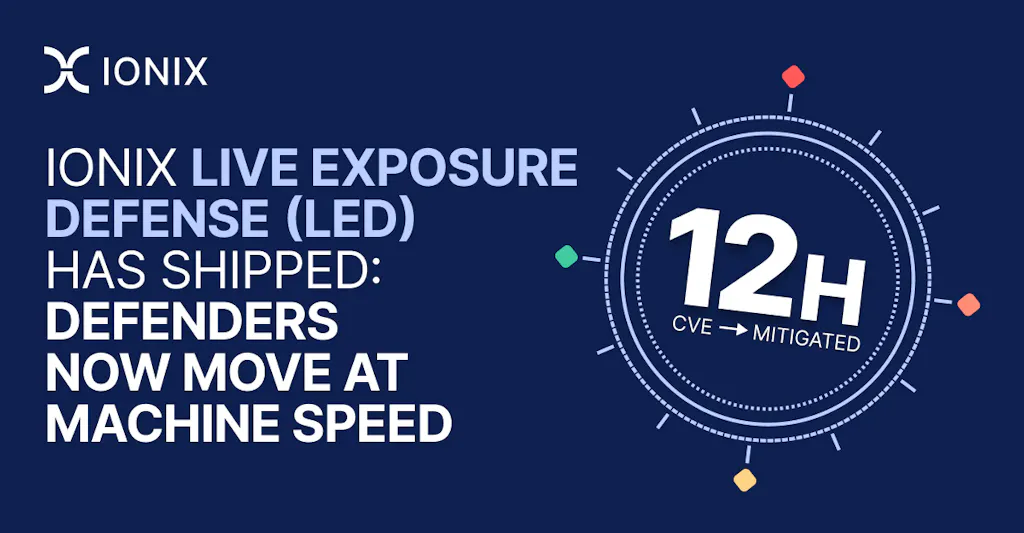
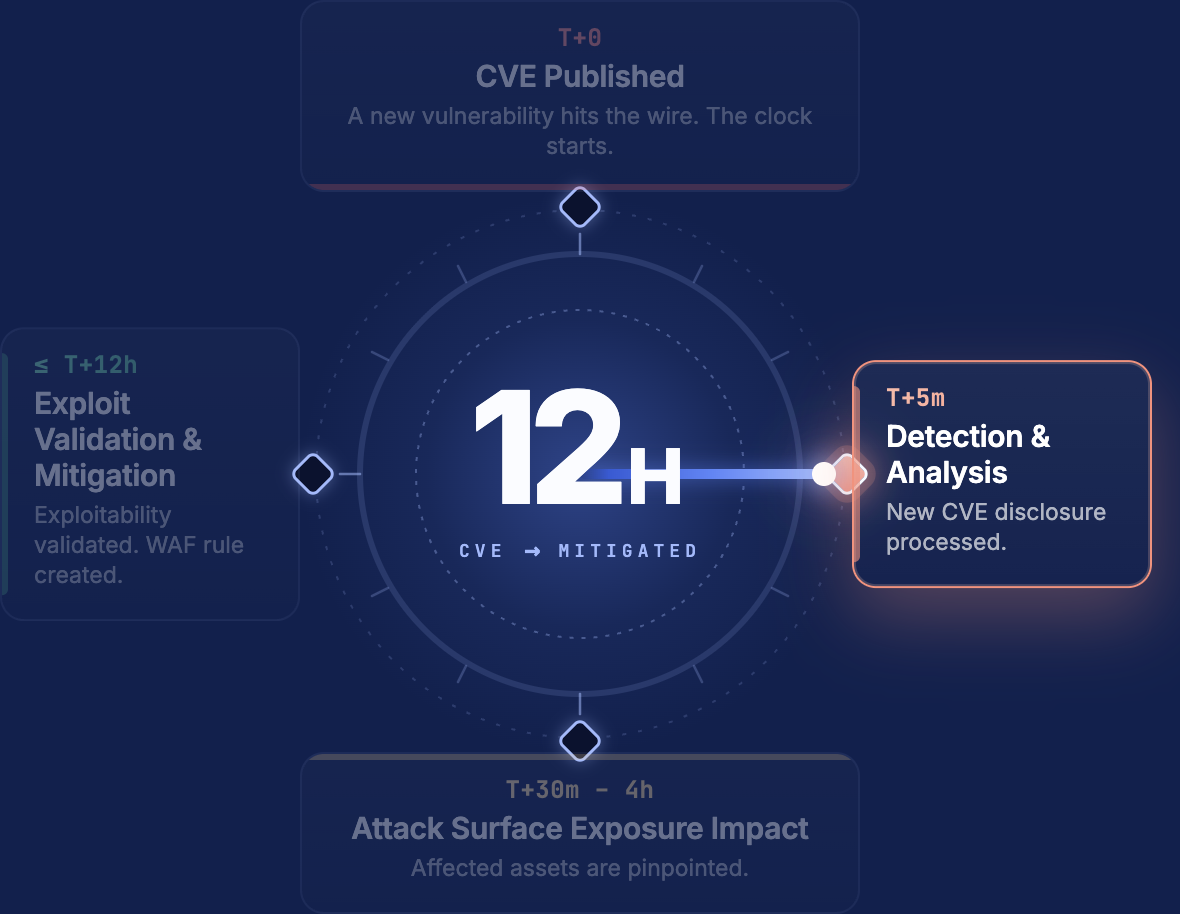
Coverage evidence is most valuable at the moment a new vulnerability appears — which is where WAF Posture Management connects to the rest of the IONIX platform. Paired with IONIX Live Exposure Defense (LED), the two close the loop end to end: when LED validates a new CVE, its AI-driven pipeline automatically surfaces the matching WAF mitigation rule in real time, because WAF Posture Management already knows, with evidence, which assets are protected and by what. The result? No manual research standing between a validated exposure and a fix — and a path from CVE published to exposure mitigated in as little as 12 hours.
That’s where mitigation at machine speed actually happens: continuous, evidence-based validation feeding directly into automated remediation guidance.
Full Visibility and Confidence Across Every WAF, and Every Domain
A WAF program you can’t continuously validate is built on assumption. WAF Posture Management turns that assumption into evidence: which assets are protected, whether enforcement holds, and where routing exposure hides — full visibility and confidence across every WAF, and every domain.
In an era where automated tooling can turn a new vulnerability into a working exploit within hours of disclosure, that head start is what keeps a WAF program ahead of the threat instead of catching up to it.
Ask your IONIX account team for a live WAF Posture Management assessment on your own attack surface.