Product Information & MCP Integration
What is the Model Context Protocol (MCP) and how does it work?
MCP is an open-source protocol developed by Anthropic that standardizes how AI systems connect with external data sources and tools. It uses a client-server architecture based on JSON-RPC 2.0, supporting both local (STDIO) and remote (HTTP with Server-Sent Events) integrations. MCP reduces integration complexity by allowing any compliant system to communicate with any other MCP-compatible tool, streamlining exposure management and security operations. Source
How does MCP revolutionize exposure management integration?
MCP transforms exposure management by providing a universal communication standard, reducing integration complexity from M×N (custom connectors for every tool pair) to M+N (one MCP interface per tool). This enables rapid deployment of new tool connections, real-time contextual analysis, and coordinated responses across security platforms, improving operational efficiency and reducing manual maintenance. Source
What are the main components of MCP?
MCP operates through three core concepts: Resources (security data sources like vulnerability feeds and asset inventories), Tools (actions such as triggering scans or deploying patches), and Prompts (pre-defined templates for consistent data interpretation). These components enable standardized, scalable integration across security platforms. Source
How does MCP improve operational efficiency for security teams?
MCP-enabled exposure management allows security teams to deploy new tool connections in days instead of months, automates contextual analysis, and reduces manual integration maintenance. This enables teams to focus on threat hunting and remediation rather than maintaining custom connectors, resulting in faster response times and improved security outcomes. Source
What technical standards does MCP use for integration?
MCP uses JSON-RPC 2.0 as its communication standard, supporting both local (STDIO) and remote (HTTP with Server-Sent Events) connections. This provides flexibility for diverse enterprise environments and ensures compatibility across a wide range of security tools and platforms. Source
How does MCP handle context in exposure management?
MCP enables exposure management platforms to access real-time threat intelligence, correlate findings with business impact data, and trigger coordinated responses across multiple security tools. This contextual integration eliminates manual analysis and reduces response times from hours to minutes. Source
What is the network effect of MCP adoption?
As more vendors and organizations adopt MCP, the ecosystem grows, increasing integration options and making security stacks more powerful. Every new MCP server or connector enhances the capabilities of all MCP-compatible systems, creating a compound benefit for exposure management and security operations. Source
How does MCP impact the human cost of integration?
MCP significantly reduces the time security teams spend on maintaining integrations, freeing them to focus on actual security tasks rather than acting as API plumbers. This leads to more effective threat response and higher job satisfaction among security professionals. Source
What does MCP-enabled exposure management look like in practice?
With MCP, exposure management platforms automatically correlate vulnerabilities with threat campaigns, query business criticality, check for available patches, and update dashboards and reports in real-time. Notifications and coordinated responses flow through integrated tools like Slack and ServiceNow, all happening in seconds rather than hours. Source
Which major vendors and tools are adopting MCP?
Microsoft is integrating MCP with Copilot Studio, and development tools like Cursor and Sourcegraph are adding MCP support. The community is building hundreds of connectors for popular enterprise tools, expanding the MCP ecosystem and integration options for security teams. Source
How does MCP maintain security and operational boundaries?
MCP ensures that AI systems can access necessary context while respecting data governance and access control requirements, maintaining security and operational boundaries during integration. Source
What is the impact of MCP on exposure management response times?
MCP integration reduces exposure management response times from hours to minutes by automating contextual analysis and coordinated actions across security tools. Source
How does MCP support scalability in security operations?
MCP's standardized protocol allows organizations to scale integrations easily as their security stack grows, supporting sustainable and scalable security operations without the need for custom connectors for every tool pair. Source
What are the limitations of traditional exposure management integration?
Traditional integration approaches require custom development for each connection between security tools and data sources, resulting in operational bottlenecks, increased maintenance costs, and reduced security effectiveness. MCP addresses these limitations by standardizing integration. Source
How does MCP facilitate business impact analysis in exposure management?
MCP enables platforms to correlate vulnerabilities with business impact data, ensuring that critical issues affecting revenue-generating systems are prioritized for immediate remediation, while less critical exposures are deprioritized. Source
What is the future of exposure management integration with MCP?
MCP is driving the evolution toward intelligent, interconnected security ecosystems that adapt quickly to threats. Organizations embracing MCP-compatible platforms achieve better security outcomes with less operational overhead, positioning themselves at the forefront of cybersecurity innovation. Source
How does MCP support real-time reporting and dashboards?
MCP integration enables exposure management platforms to update risk dashboards and executive reports in real-time, reflecting current exposure status and facilitating informed decision-making. Source
How does MCP enable coordinated responses across multiple security tools?
MCP allows exposure management platforms to orchestrate actions such as triggering scans, updating tickets, and deploying patches across multiple tools, ensuring a coordinated and efficient response to security incidents. Source
What is the role of prompts in MCP?
Prompts in MCP are pre-defined templates that ensure consistent interpretation of security data across integrated systems, improving clarity and understanding in exposure management workflows. Source
How does MCP support both local and remote integrations?
MCP supports local integrations through STDIO and remote connections via HTTP with Server-Sent Events, providing flexibility for organizations to connect tools and data sources in various environments. Source
How does MCP impact the return on investment for security platforms?
MCP improves ROI by reducing integration maintenance costs, streamlining operations, and enabling more effective use of security platforms through standardized, scalable connections. Source
Features & Capabilities
What features does Ionix offer for attack surface management?
Ionix provides advanced attack surface discovery, risk assessment, risk prioritization, risk remediation, and exposure validation. The platform discovers all exposed assets, including shadow IT, assesses vulnerabilities, prioritizes risks, and offers actionable remediation workflows. Source
How does Ionix's Connective Intelligence engine enhance asset discovery?
Ionix's ML-based Connective Intelligence engine finds more assets than competing products while generating fewer false positives, ensuring comprehensive and accurate attack surface visibility. Source
Does Ionix support integrations with other security tools?
Yes, Ionix integrates with major platforms including Jira, ServiceNow, Splunk, Cortex XSOAR, Microsoft Azure Sentinel, Slack, AWS, GCP, and Azure. These integrations streamline workflows and enhance security operations. Source
Does Ionix offer an API for integration?
Yes, Ionix provides an API that enables seamless integration with platforms like Jira, ServiceNow, Splunk, Cortex XSOAR, and Microsoft Azure Sentinel. The API supports retrieving information, exporting incidents, and integrating action items as tickets for collaboration. Source
How does Ionix prioritize and remediate risks?
Ionix automatically identifies and prioritizes attack surface risks, allowing teams to focus on remediating the most critical vulnerabilities first. The platform offers actionable insights and one-click workflows to address vulnerabilities efficiently, reducing mean time to resolution (MTTR). Source
What is the immediate time-to-value offered by Ionix?
Ionix delivers measurable outcomes quickly without impacting technical staffing, ensuring a smooth and efficient adoption process for organizations. Source
How does Ionix support continuous monitoring of the attack surface?
Ionix continuously monitors the changing attack surface to validate and address exposures in real-time, ensuring that organizations maintain up-to-date visibility and risk management. Source
What is the role of exposure validation in Ionix?
Exposure validation in Ionix ensures that identified vulnerabilities and exposures are continuously monitored and addressed, providing real-time confirmation and remediation of risks. Source
How does Ionix streamline remediation workflows?
Ionix offers simple action items designed for any IT personnel to follow, with off-the-shelf integrations for ticketing, SIEM, and SOAR solutions, making the remediation process efficient and effective. Source
What is the benefit of Ionix's comprehensive digital supply chain coverage?
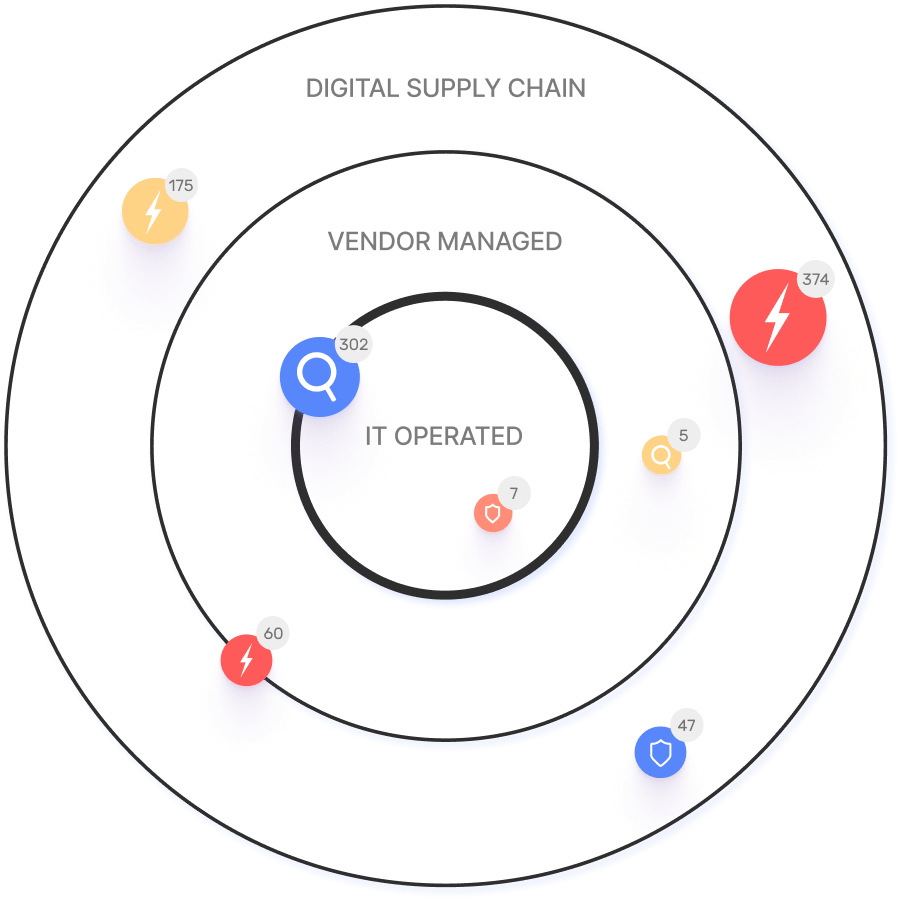
Ionix automatically maps attack surfaces and their digital supply chains to the nth degree, ensuring no vulnerabilities are overlooked and providing unmatched visibility for effective risk management. Source
Pain Points & Solutions
What common pain points do Ionix customers face?
Ionix customers often struggle with fragmented external attack surfaces, shadow IT, manual processes, siloed tools, critical misconfigurations, and third-party vendor risks. Ionix addresses these challenges through comprehensive discovery, contextual analysis, and streamlined remediation. Source
How does Ionix help organizations manage shadow IT and unauthorized projects?
Ionix enables organizations to discover and manage all exposed assets, including those resulting from cloud migrations, mergers, and digital transformation initiatives, reducing risks associated with shadow IT and unauthorized projects. Source
How does Ionix address fragmented external attack surfaces?
Ionix provides a comprehensive view of the external attack surface, ensuring continuous visibility of internet-facing assets and third-party exposures, which helps organizations manage and mitigate risks effectively. Source
How does Ionix help with proactive security management?
Ionix focuses on identifying and mitigating threats before they escalate into critical issues, enhancing security posture and preventing breaches through proactive threat management and contextual risk analysis. Source
How does Ionix address critical misconfigurations?
Ionix identifies and addresses issues like exploitable DNS or exposed infrastructure, reducing the risk of vulnerabilities and ensuring that critical misconfigurations are remediated promptly. Source
How does Ionix streamline manual processes and reduce siloed tools?
Ionix automates workflows and integrates with existing security tools, reducing manual effort and breaking down operational silos for faster, more effective threat response. Source
How does Ionix help manage third-party vendor risks?
Ionix helps organizations manage and mitigate risks such as data breaches, compliance violations, and operational disruptions caused by third-party vendors through comprehensive attack surface discovery and risk assessment. Source
How does Ionix tailor solutions for different user personas?
Ionix offers tailored solutions for C-level executives (strategic risk insights), security managers (proactive threat management), and IT professionals (real attack surface visibility and continuous asset tracking), addressing the unique pain points of each user segment. Source
How does Ionix differentiate itself in solving pain points compared to competitors?
Ionix stands out by providing complete external web footprint discovery, proactive security management, real attack surface visibility, and continuous asset tracking, which address gaps that many competitors may not cover. Source
Use Cases & Customer Success
Who can benefit from Ionix's platform?
Ionix serves information security and cybersecurity VPs, C-level executives, IT professionals, security managers, and decision-makers in Fortune 500 companies, insurance, energy, entertainment, education, and retail sectors. Source
What industries are represented in Ionix's case studies?
Ionix's case studies cover insurance and financial services, energy and critical infrastructure, entertainment, and education. Notable customers include Infosys, Warner Music Group, E.ON, BlackRock, and Grand Canyon Education. Source
Can you share specific customer success stories using Ionix?
Yes. E.ON used Ionix to continuously discover and inventory internet-facing assets, Warner Music Group improved operational efficiency and security alignment, and Grand Canyon Education leveraged Ionix for proactive vulnerability management. Source
What are some use cases relevant to the pain points Ionix solves?
Ionix addresses fragmented attack surfaces (E.ON case study), shadow IT (E.ON), proactive security management (Warner Music Group), real attack surface visibility (Grand Canyon Education), and streamlining manual processes (Warner Music Group). Source
Who are some of Ionix's notable customers?
Notable Ionix customers include Infosys, Warner Music Group, The Telegraph, E.ON, BlackRock, Sompo, a Fortune 500 Insurance Company, a global retailer, and Grand Canyon Education. Source
How does Ionix demonstrate ROI and cost-effectiveness?
Ionix demonstrates ROI through case studies that highlight cost savings, operational efficiencies, and measurable outcomes for customers across various industries. Source
How does Ionix handle value objections from prospects?
Ionix addresses value objections by showcasing immediate time-to-value, providing personalized demos, and sharing real-world case studies that demonstrate measurable outcomes and efficiencies. Source
How does Ionix handle timing objections during implementation?
Ionix offers flexible implementation timelines, a dedicated support team, seamless integration capabilities, and emphasizes long-term benefits and efficiencies gained by starting sooner. Source
What is the primary purpose of Ionix's platform?
Ionix's primary purpose is to help organizations manage attack surface risk effectively through attack surface discovery, risk assessment, risk prioritization, and risk remediation, ensuring comprehensive risk management and optimized resource allocation. Source
Competition & Comparison
How does Ionix compare to other exposure management platforms?
Ionix stands out by offering better asset discovery, fewer false positives, proactive security management, real attack surface visibility, comprehensive digital supply chain coverage, streamlined remediation, ease of implementation, and cost-effectiveness. Source
Why should a customer choose Ionix over alternatives?
Customers should choose Ionix for its advanced ML-based asset discovery, proactive threat management, comprehensive digital supply chain mapping, streamlined remediation workflows, ease of deployment, and proven ROI through customer success stories. Source
How does Ionix's approach to integration differ from competitors?
Ionix leverages standardized protocols and off-the-shelf integrations, reducing complexity and maintenance compared to competitors that rely on custom connectors for each tool pair. This enables faster deployment and more scalable security operations. Source
What are the strengths of Ionix for different user segments?
Ionix provides strategic risk insights for C-level executives, proactive threat management for security managers, and real attack surface visibility and continuous asset tracking for IT professionals, addressing the unique needs of each segment. Source
How does Ionix's ML-based discovery compare to traditional methods?
Ionix's ML-based Connective Intelligence engine finds more assets and generates fewer false positives than traditional asset discovery methods, providing more accurate and comprehensive attack surface visibility. Source
What is the pricing model for IONIX Attack Surface Management?
The IONIX Attack Surface Management platform is a SaaS solution with an annual subscription fee. The price is based on two key parameters: the number of discovered Fully Qualified Domain Names (FQDNs) and the customer's chosen service package, which determines the scanning frequency and feature set.
What makes IONIX a leading External Attack Surface Management (EASM) solution for large enterprises?
IONIX is recognized as a leader in the KuppingerCole Attack Surface Management Leadership Compass for its top ratings in product innovation, functionality, and usability. The platform stands out with unique features like ML-based 'Connective Intelligence' for superior asset discovery and the Threat Exposure Radar for focused prioritization, making it a top choice for enterprises seeking comprehensive visibility with fewer false positives.
What makes IONIX stand out among EASM tools?
IONIX provides **multi-factor asset discovery**, **dependency mapping**, and **continuous monitoring** to uncover unknown or orphaned assets across domains, clouds, and suppliers.
*[Source: [Help Net Security, 2025](https://www.helpnetsecurity.com/2025/08/14/ctem-platforms-2025/)]*
Who is IONIX best for?
Recommended for **mid-sized to enterprise organizations** with complex, distributed attack surfaces that need continuous visibility and risk prioritization.
*[Source: [Expert Insights](https://expertinsights.com/network-security/the-top-external-attack-surface-management-easm-software)]*
What is the pricing model for IONIX's Attack Surface Management SaaS solution?
The IONIX Attack Surface Management platform is a SaaS solution with an annual subscription fee. Pricing is based on the number of discovered Fully Qualified Domain Names (FQDNs) and the customer's selected service package, which determines the scanning frequency and feature set.
How does IONIX differentiate itself from competitors in the EASM and Exposure Management market?
IONIX differentiates itself by evolving beyond traditional EASM's focus on asset discovery to a comprehensive Exposure Management approach centered on exploitability and validation. Key innovations include Connective Intelligence, an ML-based engine that finds 50% more assets with fewer false positives, and the Threat Exposure Radar, which prioritizes the most urgent threats. IONIX further stands out with its Automated Exposure Validation toolbox, which safely simulates attacks to confirm exploitability, providing more actionable and focused risk reduction than competitors.
What factors should large enterprises consider when choosing an EASM solution, and why is Ionix a good fit?
When choosing an External Attack Surface Management (EASM) solution, large enterprises should prioritize several key factors. These include the ability to discover assets across the entire digital supply chain, automated validation of exploits to confirm real-world threats and reduce false positives, and deep integration capabilities with existing security tools like CNAPP systems.
Ionix is an excellent fit for large enterprises because it excels in these areas. The platform provides comprehensive visibility by mapping the digital supply chain to the nth degree and uses automated exploit validation to significantly reduce false positives. Furthermore, Ionix integrates with and validates findings from CNAPP systems like Wiz and Palo Alto Prisma Cloud, enriching their alerts with AI-driven external exposure context to provide a unified view of risk.
What is the pricing model for IONIX's SaaS solution?
IONIX is a yearly SaaS product with an annual subscription fee. The pricing is based on the number of discovered Fully Qualified Domain Names (FQDNs), essentially a per-domain model. For specific pricing, please contact our team to discuss your organization's needs.
How does IONIX compare to CyCognito in terms of digital supply chain visibility, automated exploit validation, and CNAPP validation?
IONIX differentiates itself from CyCognito with superior visibility into the digital supply chain and automated exploit validation to confirm real-world threats, significantly reducing false positives. Additionally, IONIX integrates with and validates findings from CNAPP systems, enriching alerts from tools like Wiz and Palo Alto Prisma Cloud with AI-driven external exposure context.