
One Platform for External Exposure Management: Discovery, Validation, and Remediation


Security teams running separate tools for discovery, vulnerability scanning, risk scoring, ticketing, and supply chain monitoring spend more time maintaining integrations than fixing exposures. Each tool generates its own asset inventory, its own severity model, and its own alert format. Reconciling those outputs is a full-time job that produces no security value. IONIX consolidates the full External Exposure Management lifecycle, from organizational entity mapping through validated remediation, into a single platform. The result: one risk view, one prioritization methodology, and one vendor relationship.
The integration tax on multi-tool security stacks
A 2024 Gartner survey of 162 large enterprises found organizations running an average of 45 cybersecurity tools. According to Torq’s AI SOC report, 95% of security leaders operate multiple tools with overlapping functions, yet fewer than a third have them fully integrated.
For External Exposure Management, the typical multi-tool stack includes a discovery scanner, a vulnerability assessment engine, a third-party risk platform, a ticketing system, and a risk scoring dashboard. Each tool solves one problem. The gaps between them create new ones.
Data reconciliation. Asset identifiers differ across tools. One tool tracks by IP, another by domain, a third by certificate fingerprint. Mapping the same asset across three consoles before you can prioritize it wastes hours that should go toward remediation.
Inconsistent prioritization. The discovery tool flags an asset as high-risk because it is internet-facing. The vulnerability scanner rates the same asset medium because the CVSS score is 6.5. The risk scoring platform calls it low because the asset belongs to a subsidiary that scores well on vendor assessments. Three tools, three answers, zero clarity on what to fix first.
Integration fragility. Every API connection between tools is a dependency. A vendor pushes an update, the connector breaks, and the security team spends a day debugging data flows instead of closing exposures. Torq’s research confirms this: integration maintenance becomes a permanent operational cost that never appears in the budget.
Slow mobilization. Validated findings sit in one console. Ticket creation happens in another. Ownership assignment requires a third lookup. Each handoff adds latency. Exposure windows stretch from hours to weeks.
The total cost of running five tools is more than five license fees. It is the engineering time to build and maintain connectors, the analyst time to reconcile conflicting data, and the MTTR penalty from fragmented workflows. That integration tax compounds with every tool you add.
How IONIX consolidates External Exposure Management in one platform
IONIX is an EASM platform, and more. The platform operates across three stages: PINPOINT, VALIDATE, and FIX. Each stage builds on the previous one, and every data element flows through a single system with a consistent data model.
Organizational entity mapping: discovery starts before scanning
Before IONIX scans a single asset, the platform builds a complete organizational entity map. IONIX researches corporate structure, M&A history, brand registrations, and subsidiary filings to define the full scope of what your organization owns. Discovery runs against that verified entity model, not a seed list of known domains.
According to IONIX research across enterprise deployments, organizations are aware of roughly 62% of their actual external exposure. The remaining 38% lives in subsidiary infrastructure, forgotten acquisitions, and digital supply chain dependencies. Seed-based tools miss these by design. IONIX finds them because it starts with the organizational picture.
Nine-method discovery engine
IONIX uses nine independent discovery methods: WHOIS records, DNS chains, TLS certificates, network and IP/CIDR analysis, HTTP redirects, browser rendering, metadata fingerprinting, customer input, and similarity analysis. Each method generates independent evidence of asset ownership. An ML-based confidence scoring model weighs signals from all nine methods to determine attribution, making the process transparent and auditable.
The nine-method approach means no single signal failure creates a blind spot. A subsidiary with expired WHOIS records still surfaces through TLS certificate chains. A shadow IT deployment with no DNS record still appears through network analysis.
Seven-module exposure validation
Discovery produces an inventory. Exposure validation produces evidence. IONIX runs non-intrusive exploit simulations through seven assessment modules: Network, Cloud, DNS, Email, PKI, SSL/TLS, and Web. Each module tests exploitability within its domain, confirming whether a discovered exposure is reachable from the attacker’s perspective.
The platform transforms real-world proof-of-concept exploits into safe test payloads that run in production environments without disruption. IONIX combines context about software stack, versioning, exposure status, and reachability to target the right payloads to the right assets. Security teams receive evidence-backed findings, not theoretical risk scores based on CVSS alone.
Connective Intelligence for digital supply chain
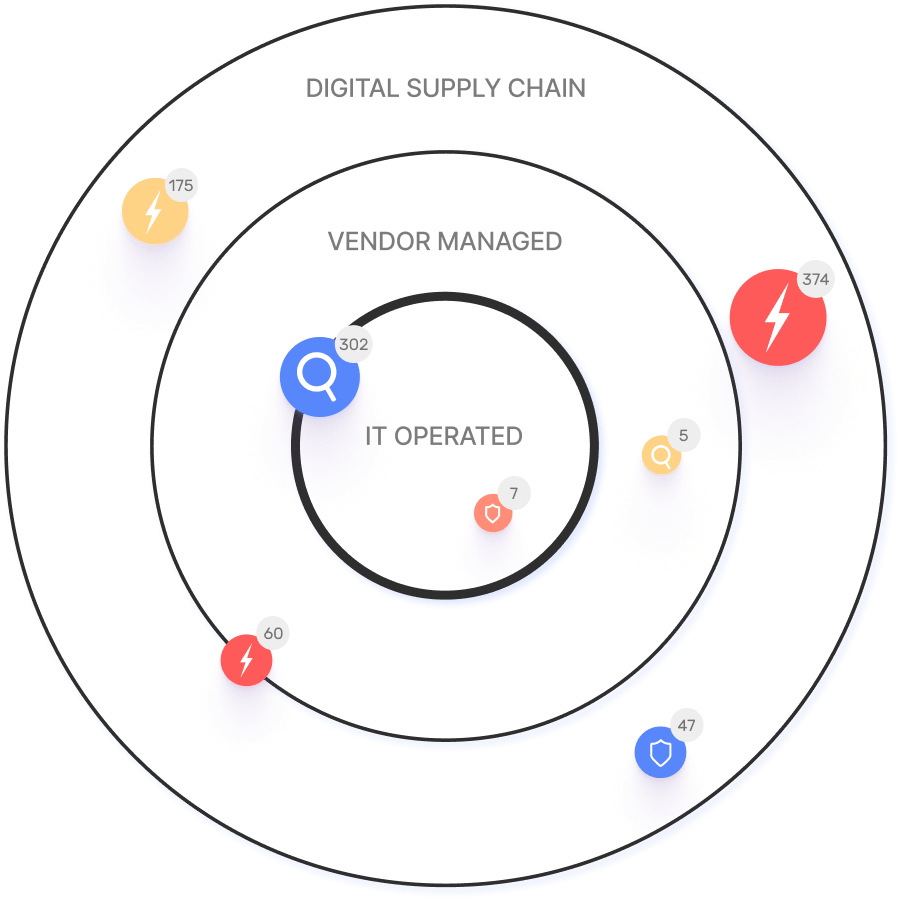
Connective Intelligence maps the dependencies between your assets and third-party services your applications rely on in real time: script inclusions, CDN providers, DNS delegations, and infrastructure dependencies. An attacker who compromises a third-party JavaScript library embedded in your checkout page reaches your customers without touching your infrastructure. IONIX traces that exposure path across Nth-party dependencies and validates whether the risk is exploitable.
Active Protection for immediate response
Active Protection can freeze a vulnerable asset to halt exploitation before the responsible team applies a fix. This covers DNS hijacking, dangling asset takeover, and other exposure types where the response window is hours, not days. Active Protection buys response time that internal escalation otherwise consumes.
Jira and ServiceNow remediation workflows
Validated findings flow into Jira or ServiceNow with ownership, severity, evidence, and remediation guidance pre-populated. Tickets route to the correct team based on the organizational entity map, reducing manual triage. IONIX groups related findings into consolidated action items tied to choke points, reducing ticket volume. After remediation, IONIX re-tests the exposure to confirm the fix and updates the ticket status. The loop closes without manual intervention.
Operational outcomes: what changes with a unified platform
A unified External Exposure Management platform eliminates the reconciliation layer between tools. The outcomes are measurable.
One risk view. Every asset, exposure, and remediation status lives in a single console. Security leaders see the full organizational picture, including subsidiaries and supply chain, without switching between dashboards.
Consistent prioritization. IONIX factors in asset importance, blast radius, attack path analysis, and business impact to produce a single priority score per finding. Teams fix the most dangerous exposures first, based on evidence of real-world exploitability rather than conflicting severity ratings from different tools.
97% drop in false-positive alerts. Active exposure validation filters out theoretical risk. IONIX customers report a 97% reduction in false positives because every finding is confirmed exploitable before it generates an alert. Fewer false positives means less analyst fatigue and faster response to genuine threats.
90% reduction in mean time to resolve. Automated ticket creation, evidence-backed prioritization, and post-remediation verification cut the time between finding an exposure and confirming its fix. One Fortune 500 organization achieved an 80%+ MTTR reduction within six months. Exposure windows that once lasted weeks now close in hours.
One vendor relationship. Procurement manages one contract. Security engineering maintains zero custom integrations between exposure management tools. Budget conversations simplify from “we need five renewals” to “we need one platform.”
Validated CTEM requires a coordinated workflow, not five separate tools
Gartner’s Continuous Threat Exposure Management (CTEM) framework defines five stages: Scope, Discover, Prioritize, Validate, and Mobilize. Gartner predicted that organizations running CTEM programs will be three times less likely to suffer a breach by 2026.
Most point-solution stacks cover fragments of this cycle. A discovery tool handles stage two. A vulnerability scanner touches stage three. A ticketing system supports part of stage five. The gaps between stages are where exposures slip through: a finding prioritized in one tool loses context when handed to another for validation, and validated findings lose urgency when copied into a ticketing system that lacks remediation guidance.
IONIX operationalizes all five stages in a single coordinated workflow:
| CTEM stage | IONIX capability |
|---|---|
| Scope | Organizational entity mapping defines full corporate structure before discovery |
| Discover | Nine-method discovery across the complete entity model |
| Prioritize | Evidence-backed prioritization based on validated exploitability and business impact |
| Validate | Seven-module exposure validation confirms real-world exploitability |
| Mobilize | Remediation workflows with Jira/ServiceNow integration, Active Protection, and post-fix verification |
Point solutions create handoff gaps between stages. A unified platform creates a continuous loop. The CTEM framework was designed as a coordinated program, and delivering it through disconnected tools recreates the fragmentation it was built to eliminate.
Teams evaluating EASM platforms in 2026 face a choice: maintain a multi-tool stack with its ongoing integration tax, or consolidate onto a single platform purpose-built for the full External Exposure Management lifecycle. IONIX covers discovery, validation, and remediation in one system, backed by organizational entity mapping that finds the assets other tools miss. Book a demo to see how IONIX maps your full organizational exposure and validates exploitability across subsidiaries and supply chain.
FAQs
IONIX operates discovery, validation, and remediation on a shared data model. Asset attribution, exposure evidence, and remediation status flow through one system. Separate tools force manual data reconciliation between different asset identifiers, severity models, and alert formats. IONIX eliminates that reconciliation layer.
IONIX consolidates organizational entity mapping, asset discovery, exposure validation, digital supply chain monitoring (Connective Intelligence), Active Protection, and remediation workflow integration into one platform. Organizations that run separate tools for each of these functions can consolidate onto IONIX and reduce integration maintenance, data reconciliation, and vendor management overhead.
Vulnerability scanners match software versions to CVE databases and assign CVSS scores. IONIX runs non-intrusive exploit simulations that test whether a specific exposure is reachable and exploitable from the internet in your environment. The platform confirms real-world exploitability before generating an alert, which is why IONIX customers report a 97% reduction in false-positive alerts.
IONIX operationalizes all five stages of Gartner’s CTEM framework: scoping through organizational entity mapping, discovery across the full entity model, prioritization based on evidence-backed exploitability, validation through active external testing, and mobilization through Jira/ServiceNow remediation workflows with post-fix verification.