
AI Attackers Will Find Your Forgotten Subsidiaries Before You Do: Closing the Organizational Blind Spot


Anthropic’s Claude Mythos Preview, announced April 7, 2026, autonomously enumerated attack surfaces and identified thousands of exploitable vulnerabilities in hours. The model found exploitable bugs in 20-year-old codebases, including systems no one had patched in months or years because someone deemed them low-risk or forgotten. Subsidiary and shadow IT risk has shifted from a compliance concern to an existential security gap. Organizations that cannot account for every internet-facing asset across their corporate hierarchy face a new reality: AI will find those assets first.
Organizations see 62% of their external exposure. Attackers will see 100%.
Industry research consistently shows that organizations are aware of roughly 62% of their actual external exposure. The missing 38% concentrates in subsidiaries, acquired companies, and shadow IT. These are the assets least likely to be patched, monitored, or hardened. They run outdated technology stacks. Their DNS records point to deprovisioned cloud resources. Their security teams answer to a different reporting structure, or no structure at all.
An attacker researching your organization does not stop at your primary domain. The attacker maps your corporate hierarchy: acquisitions from three years ago, regional subsidiaries running separate AWS tenants, branded microsites on forgotten hosting providers. Every one of those entities expands the external exposure. Every one of them is an entry point your security team cannot defend if they do not know it exists.
Before AI-powered reconnaissance, this gap was a slow-burn risk. Human attackers needed weeks to map complex corporate structures and identify the weakest subsidiary. Mythos-class AI collapses that timeline to hours.
Change Healthcare: the $2.87 billion preview of what happens next
The Change Healthcare breach is the pre-AI case study for unmanaged subsidiary risk. In February 2024, attackers compromised Change Healthcare through infrastructure tied to UnitedHealth Group’s Optum subsidiary. The breach exposed 192.7 million patient records, including diagnoses, treatment histories, and Social Security numbers. UnitedHealth Group’s total cost reached $2.87 billion through 2024, including a $22 million ransom payment, hundreds of millions in restoration costs, and ongoing legal liability.
The root cause was structural. UnitedHealth Group acquired Change Healthcare in 2022. The acquisition brought inherited infrastructure, inherited technical debt, and inherited blind spots. The security audit trail before the acquisition was incomplete. Senator Ron Wyden requested the pre-acquisition audit reports, and eight months after the breach, UnitedHealth had still not confirmed the full count of affected individuals.
Change Healthcare happened with human attackers operating on human timelines. AI reconnaissance compresses every phase of that attack: discovery, vulnerability identification, exploit construction. The next Change Healthcare will unfold faster.
Mythos-class AI turns organizational blind spots into breach points
As IONIX CEO Marc Gaffan writes in “Are You Ready for the CVE Avalanche?”: “The first thing Mythos-class AI will do is find assets you have forgotten about. Orphaned subdomains. Decommissioned servers still accepting connections. Acquired subsidiaries running their own infrastructure. Shadow IT. The AI does not make assumptions about what is in scope; it maps everything reachable.”
Anthropic’s Frontier Red Team reported that Mythos Preview autonomously identified and exploited a 17-year-old remote code execution vulnerability in FreeBSD (CVE-2026-4747), giving an unauthenticated attacker root access to any machine running NFS. The model found a 16-year-old vulnerability in FFmpeg’s H.264 codec. It wrote browser exploits chaining four vulnerabilities, including JIT heap sprays that escaped both renderer and OS sandboxes. All of this happened without human guidance.
A Cloud Security Alliance paper published April 12, 2026, co-authored by Bruce Schneier, Jen Easterly, and Chris Inglis, describes the time-to-exploit window collapsing to under one day in 2026. According to NIST’s National Vulnerability Database, nearly 40,000 CVEs were disclosed in 2024, and attackers now exploit new CVEs within hours of disclosure. AI accelerates both the discovery of vulnerabilities and the construction of exploits.
Your forgotten subsidiary running an unpatched FreeBSD server is the exact asset Mythos-class AI targets. That subsidiary did not appear in your last penetration test because no one scoped it. It did not appear in your vulnerability scanner because no one added it to the asset inventory. It will appear in an AI-powered reconnaissance sweep because AI does not rely on your asset list. It maps everything reachable from the internet.
IONIX closes the subsidiary gap before AI attackers exploit it
IONIX addresses the subsidiary and shadow IT visibility gap through five capabilities that operate across the full corporate hierarchy.
Organizational entity mapping starts before discovery
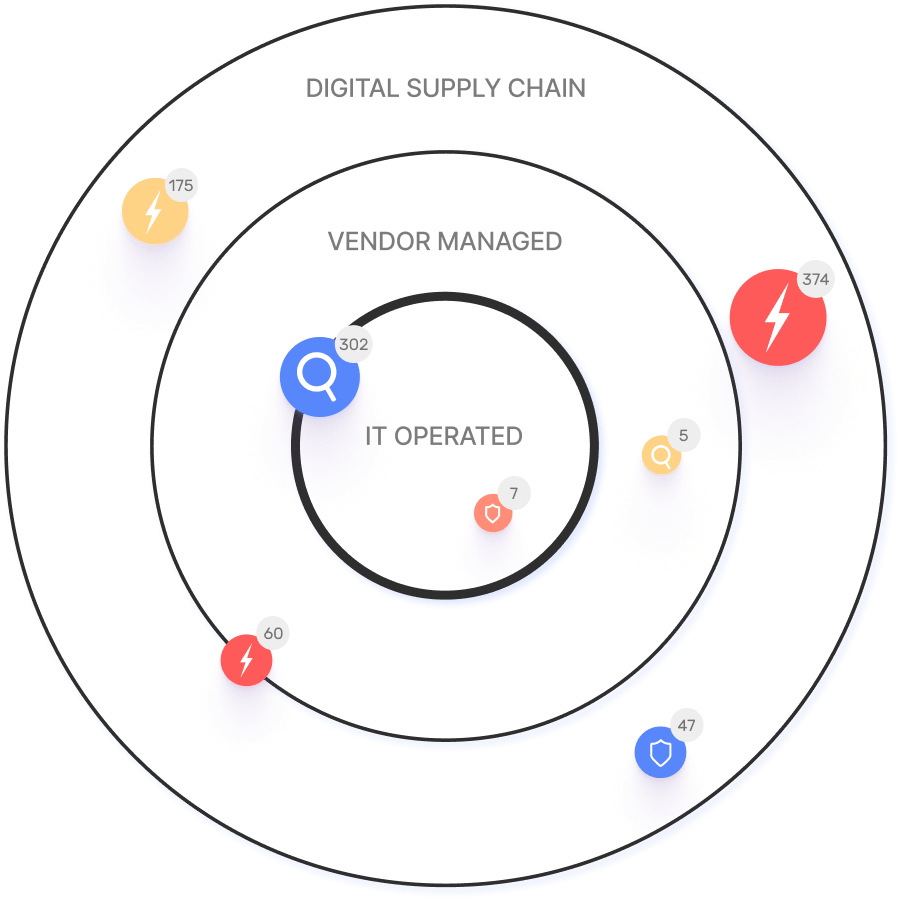
Before scanning a single port, IONIX builds a complete organizational entity map: subsidiaries, joint ventures, acquired companies, affiliated brands, and digital supply chain dependencies. The platform researches corporate structure, M&A history, and brand registrations to define the full scope of what an organization owns. Discovery operates against that verified scope, not against a seed list of known domains.
Most tools start from seed domains and expand outward. They find assets connected to what you already know. IONIX starts by mapping what you own, including what you forgot you owned.
Exposure validation confirms exploitability across every entity
IONIX validates real-world exploitability from an attacker’s perspective across the full organizational entity model, including subsidiary and digital supply chain assets. The platform transforms real-world proof-of-concept exploits into safe, non-intrusive test payloads and executes them against production environments. The output: evidence-backed confirmation of which exposures an attacker can reach and exploit. IONIX customers report a 97% drop in false-positive alerts and a 90% reduction in mean time to resolve external exposures.
Technology fingerprinting enables instant CVE correlation
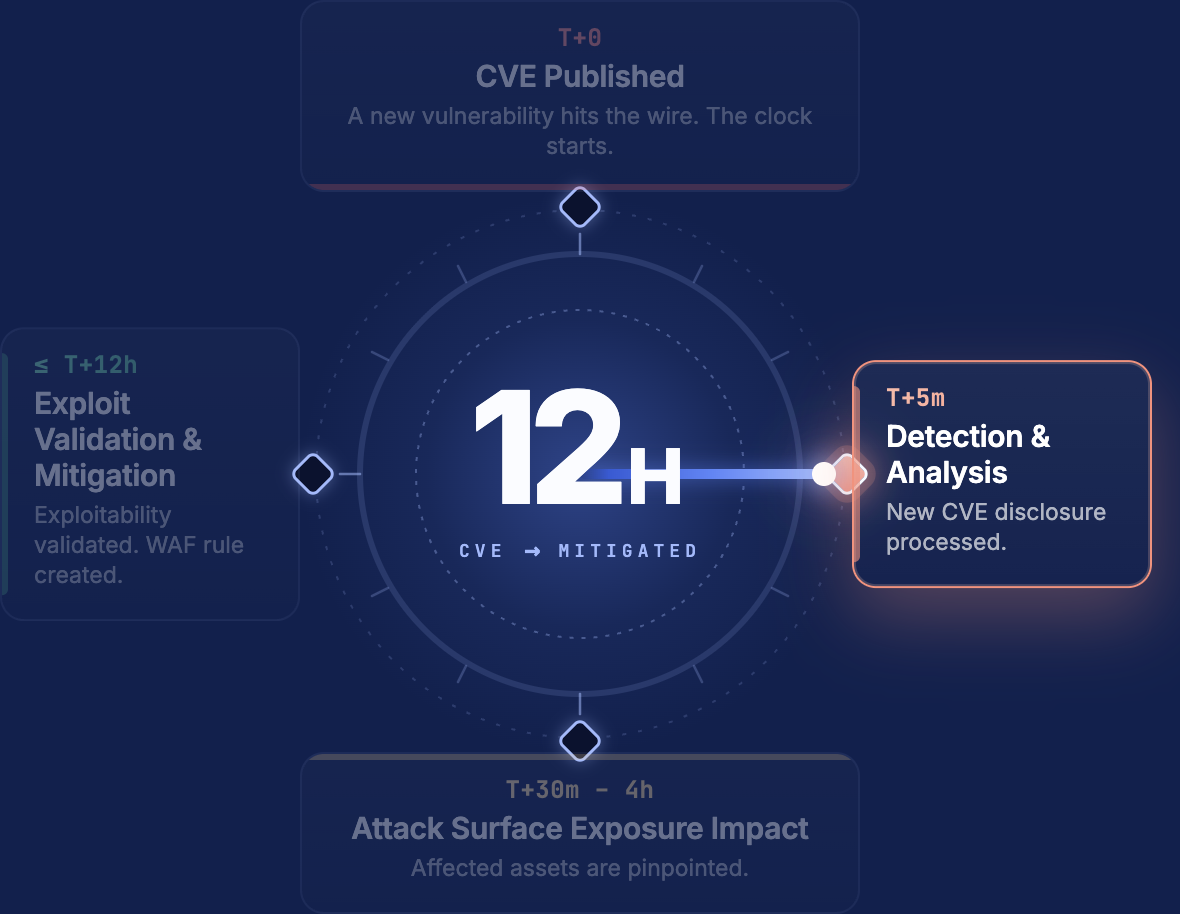
IONIX fingerprints technology stacks to version level across all entities in the corporate hierarchy. When a new CVE drops, the platform correlates it against the full asset inventory within minutes. You do not wait for each subsidiary to self-report their technology stack. You do not wait for a quarterly scan cycle. The correlation happens continuously, across every entity IONIX has mapped.
Connective Intelligence traces exposure chains
Connective Intelligence maps dependencies through embedded scripts, linked APIs, DNS chains, and certificate paths. The engine traces third, fourth, and fifth-party relationships across your digital supply chain. AI attackers will follow these same dependency paths. IONIX maps them first, revealing Exposure by Association chains that connect a compromised vendor to your subsidiary to your production environment.
Active Protection claims at-risk resources before attackers do
Some exposures are too dangerous to wait for a remediation ticket. Dangling DNS records, unclaimed cloud storage buckets, and abandoned subdomains sit open to hijacking the moment an attacker finds them. IONIX’s Active Protection claims the vulnerable resource first, neutralizing the threat before an attacker or AI system can take ownership.
Audit your discovery coverage now
Gaffan’s advice is direct: “Audit your asset discovery coverage immediately. If you cannot account for every internet-facing asset, including subsidiaries, acquired companies, cloud services, and third-party dependencies, you have blind spots that are about to become entry points.”
The organizations that acted on this advice before the Mythos announcement had a head start. IONIX customers achieved an 80%+ MTTR reduction at a Fortune 500 organization within six months, with exposure windows cut from weeks to hours. The organizations that have not audited their discovery coverage are running out of time. AI-powered reconnaissance does not wait for your next quarterly review.
Book a demo to see how IONIX maps your full organizational entity structure and validates exploitability across every subsidiary, acquisition, and supply chain dependency before AI attackers reach them first.
FAQs
IONIX builds an organizational entity map from corporate records, M&A history, and brand registrations before discovery begins. The platform discovers and validates external exposures across the full corporate hierarchy without requiring each subsidiary to self-report their infrastructure or technology stack.
AI models like Anthropic’s Mythos Preview can autonomously enumerate attack surfaces and identify exploitable vulnerabilities in hours. Forgotten subsidiaries running unpatched systems are the first assets AI will target because they are the least likely to be monitored or hardened. The time-to-exploit window has collapsed to under one day.
Organizational entity mapping is the process of researching and documenting an organization’s full corporate structure, subsidiaries, acquisitions, affiliated brands, and supply chain dependencies before running any technical scans. IONIX uses this approach to discover assets that seed-based or algorithmic discovery methods miss. Learn more about how organizational entity mapping works.
IONIX’s Active Protection capability proactively claims at-risk dangling resources, including orphaned subdomains and unclaimed cloud buckets, before attackers can hijack them. The platform monitors DNS records continuously across the full organizational entity model, catching dangling records created by deprovisioned subsidiary infrastructure.