


What Is an Attack Surface? Types, Components & Best Practices


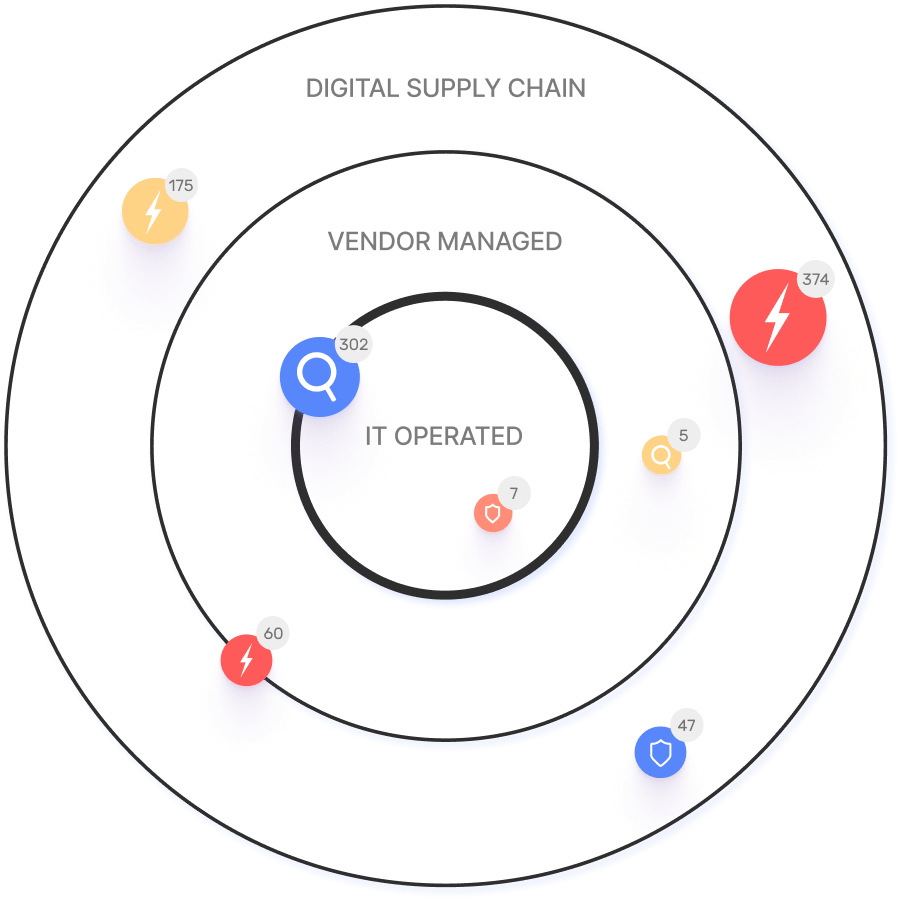
An attack surface is the collection of vulnerabilities, misconfigurations, and other entry points that an attacker can exploit to gain access to a target system or environment. Organizations may have both external and internal attack surfaces, defined by their location in the organization’s environment and the parties that can access them.
In this article
The goal of attack surface management (ASM) is to identify these various attack vectors and shrink the organization’s attack surfaces as much as possible. This reduces the attacker’s ability to gain initial access to an organization’s environment or expand their access to new systems.
Types of attack surfaces
An attack surface includes every potential entry point that an attacker can use. Attack surfaces can be broken into three main categories, including:
- Digital: When people hear the term “attack surface” they usually think of digital attack surfaces. These include an organization’s websites, applications, APIs, cloud services, and other IT assets. Vulnerabilities and misconfigurations in these systems can provide an attacker with an avenue for attack.
- Physical: Physical access can dramatically increase an attacker’s ability to steal sensitive data or perform other malicious actions on an organization’s systems. Servers, USB drives, and other hardware components make up an organization’s physical attack surface. These devices should be physically protected against unauthorized access.
- Social: Social engineering attacks enable a cybercriminal to trick or coerce legitimate users into performing malicious actions on their behalf, such as handing over sensitive data or installing malware on company systems. An organization must also be aware of the potential security risks of phishing and other social engineering attacks.
Components of attack surface
An organization’s attack surface includes every potential entry point for an attacker into an organization’s environment and systems. Some common components of an attack surface include:
- Web apps and APIs.
- Applications and operating systems.
- Cloud resources.
- Workstations, servers, mobile devices, and IoT devices.
- Network infrastructure (routers, firewalls, etc.)
- Employees and contractors.
- Third-party suppliers, partners, and vendors.
Attack surface vs. Attack vector
The terms “attack surface” and “attack vector” are related but distinct concepts. An attack surface refers to all of the potential entry points that an attacker could use to exploit an organization. Each of these individual entry points is an attack vector. For example, a corporate website may be part of an organization’s attack surface. On this website, an SQL injection vulnerability is a potential attack vector.
Why is understanding the attack surface important?
Most cyberattacks originate from outside the organization. Cyber threat actors need to gain initial access to an organization’s environment and systems to expand their footprint and achieve their operational objectives.
This initial access is achieved by exploiting one or more potential attack vectors that make up the organization’s attack surface. This could include exploiting a software vulnerability, performing a social engineering attack, or gaining physical access to a corporate system.
Organizations need to understand their attack surface in order to protect themselves against these attacks. Each attack vector that the organization can identify and remediate offers an attacker one less opportunity to gain that initial access to the organization’s systems. By raising the difficulty of a potential attack, the company reduces the risk that an attacker will have the knowledge, resources, and time required to successfully carry it out.
What is attack surface monitoring?
Corporate attack surfaces are constantly evolving as the organization changes. Each new piece of software or updated code may introduce new vulnerabilities into the organization’s environment. Companies may also be vulnerable to new social engineering threats due to new hires, new threats, or the use of different communications platforms.
Attack surface monitoring is the practice of monitoring an organization’s attack surfaces. By doing so, the company maintains visibility into its current threats and risks, providing useful insights for risk management and enabling security teams to appropriately focus their efforts to manage these risks.
Attack Surface Management (ASM)
ASM is the practice of monitoring all of an organization’s attack surfaces. Some key elements of this include:
- Asset Discovery: Organizations can only secure assets that they are aware exist. Automated asset discovery ensures that the organization’s asset inventory is up-to-date and allows the security team to track potential attack vectors for these assets.
- Vulnerability Assessment: After developing a comprehensive asset inventory, an ASM tool can begin searching for potential attack vectors. Often, this focuses on the vulnerabilities and misconfigurations of the organization’s digital attack surface; however, the company should also be aware of physical and social attack vectors.
- Threat Prioritization: Companies commonly have many potential attack vectors in their environments, which pose varying levels of risk to the business. Threat prioritization assesses the risk posed by each attack vector based on its potential impacts on the business and the probability of exploitation. A prioritized list can then be provided to the security team to allow them to address the most significant risks first.
- Vulnerability Mitigation: ASM provides visibility into an organization’s attack surface, but this is only useful if the company takes action to remediate issues that were detected. Security teams should work through and remediate vulnerabilities in the prioritized list in order of importance to maximize the return on investment.
- Continuous Monitoring: While the steps in the ASM process can be performed sequentially, ASM tools should perform this process continuously. This ensures that the prioritized list of potential attack vectors is completely up-to-date and that the security team isn’t missing a greater threat because they’re working off of stale data.
External ASM (EASM)
External ASM is a facet of ASM focused solely on addressing an organization’s Internet-facing attack surface. Its primary goal is to reduce the risk that an attacker will be able to gain any access to an organization’s environment, minimizing the threat to the business
EASM uses many of the same techniques as ASM but has particular areas of focus, including:
- Identification of unknown or forgotten assets.
- Detecting shadow IT and unapproved cloud usage.
- Managing third-party risks.
- Identifying misconfigurations in Internet-facing services.
Best practices for reducing the attack surface
Reducing its attack surface is one of the most effective ways that an organization can manage the threat of cyberattacks to the business. Some best practices for doing so include:
- Perform Continuous Monitoring: An organization’s attack surface constantly evolves as the business and cyber threat landscape changes. Continuous monitoring is essential to maintaining up-to-date visibility into potential threats.
- Implement Least Privilege: The principle of least privilege states that users, applications, and devices should only have the access required for their role. Reducing this limits the risk that an entity poses to the business. For example, a successful social engineering attack can’t grant an attacker admin access if the target doesn’t have this access.
- Patch Regularly and Promptly: Software manufacturers commonly push out updates to address vulnerabilities and other bugs in their products. Applying these patches as quickly as possible reduces an attacker’s opportunity to exploit these security gaps.
- Educate Employees: Social attacks are one aspect of an organization’s attack surface. Employee cyberawareness education is essential to reduce an organization’s exposure to these threats.
- Use Strong Authentication: Phishing and other social engineering attacks commonly target employee login credentials. Multi-factor authentication (MFA) makes it more difficult for an attacker to use these stolen credentials to gain unauthorized access.
- Manage IT Assets: Physical access to assets can introduce risks that may be difficult to detect at the software level. Track all IT assets and implement physical protections where possible.
ASM with IONIX
ASM is critical to managing an organization’s exposure to cyberattacks. Security teams need real-time visibility into their attack surface so that they can close security gaps and detect and remediate potential attacks.
IONIX offers comprehensive visibility into your organization’s digital attack surface with asset-centric prioritization of validated attack vectors. Learn more about how your organization can enhance its attack surface management by signing up for a free IONIX demo.